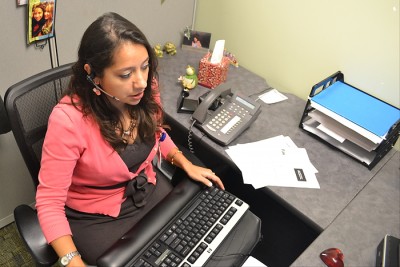
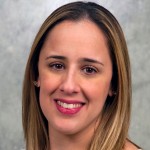
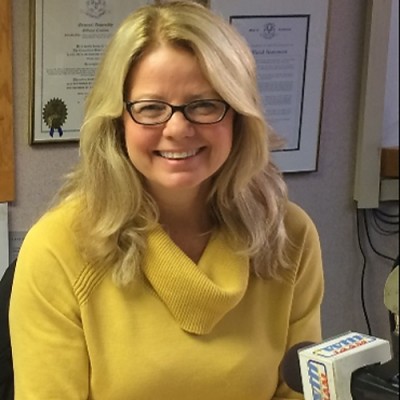
Leslie Caromile is a senior postdoctoral fellow in UConn Healths Center for Vascular Biology. (Chris DeFrancesco/UConn Health Photo)
UConn Health postdoctoral fellow Leslie Caromile is celebrating two major accomplishments.
Caromile, who studies prostate cancer in the Center for Vascular Biology, is one of six members of the Keystone Symposia Fellows Class of 2015-2016. Additionally, she has received a grant from the National Institutes of Health for her research.
The Keystone Symposia on Molecular and Cellular Biology offers this fellowship program for postdocs as it seeks to draw researchers from underrepresented populations to study life sciences. Fellows must demonstrate a commitment to inclusiveness in the life sciences and mentor young scientists from underrepresented populations.
“I have been passionate about science for as long as I can remember,” Caromile says. “I spent my childhood at natural history museums and science fairs, on camping trips and nature hikes, in vegetable gardens and green houses, and with telescopes and microscopes.”
Caromile’s research on the transmembrane peptidase prostate specific membrane antigen (PSMA) and its function in prostate cancer tumor behavior is supported by the NIH/National Cancer Institutue K01 Mentored Research Scientist Award to Promote Diversity, amounting to more than $500,000 over five years.
“I am tremendously honored to receive both these awards and to be included in these groups of highly motivated researchers,” Caromile says. “I am looking forward to not only an active role as a scientist here at UConn Health but also as an active mentor and mentee.”
Caromile is of Eastern Cherokee heritage. She works in the laboratory of Linda Shapiro, director of the Center for Vascular Biology.
“Leslie Caromile is a gifted and innovative researcher who has independently developed an observation into a fascinating story unraveling critical mechanisms driving prostate tumor progression,” Shapiro says. “The award of the mentored training grant from the National Cancer Institute and her selection as a Keystone Fellow exemplify the caliber of her research and her dedication to promoting science education.”
December brings three new art exhibits to UConn Health.
Power Boothe’s “New Work” exhibition is at UConn Health Dec. 7 through March 3.
Power Boothe, a professor of painting at the University of Hartford’s Hartford Art School, will have his “New Work” exhibition on display in the Celeste LeWitt Gallery in the Food Court Dec. 7 through March 3. It is shown courtesy of the Fred Giampietro Gallery in New Haven.
Boothe, who lives in western Connecticut, has had more than 20 one-person exhibitions in New York City and nationally. The collections at the Wadsworth Atheneum Museum of Art and the New Britain Museum of American Art include his work, as do those of the Guggenheim Museum, the Museum of Modern art, and the Whitney Museum of American Art. Honors he has received include the Guggenhein Fellowship for Painting, a National Endowment Individual Artist’s Fellowship, and a Pollock/Krasner Fellowship.
John Lo Presti’s “Composing the rectangle” exhibition is at UConn Health Dec. 7 through March 3.
Also on display in the LeWitt Gallery Dec. 7 through March 3 is John LoPresti’s “Composing the rectangle.” LoPresti, of Wethersfield, has been painting for more than 35 years, often inspired by landscapes of his environment and travels throughout New England and Europe.
Many of LoPresti’s pieces originate en plein air (in open air) with charcoal and pastel, leading to oil paintings on canvas. He’s shown a particular fondness for the land and sea of Deer Isle, Maine, and rural Mediterranean Europe.
Charles Reyburn’s exhibition “The Seasons” is at UConn Health Dec. 10 through Feb. 29.
From Dec. 10 through Feb. 29, New London native Charles Reyburn’s “The Seasons” is on display in the lobby and mezzanine. Reyburn is considered one of the rare en plein air in southeastern Connecticut, working his paintings through elements of nature rather than in a studio. His style has been compared to that of the impressionists of the past, capturing a scene’s essence in a way that allows the viewer’s imagination to work into the painting.
Reyburn attended the Rhode Island School of Design in the late 1970s. His work is included in the Lyman Allyn Art Museum’s collection.
The UConn Health Art Advisory Committee invites viewings from 8 a.m. to 9 p.m. daily.
UConn Health’s collection of fine art serves to enhance the environment and promote the sense of a caring community for patients, visitors, staff and students. Art is selected, acquired and exhibited by the UConn Health Art Advisory Committee. To view a selection of the permanent collection visit http://auxiliary.uchc.edu/art-collection.
On Monday, Dec. 7, at 6 a.m., West Road will transition to two-way traffic from the Academic Building Entrance intersection to Main Road.
The transition will open the entire length of West Road to two-way traffic beginning at the Munson/Middle Road campus entrance. Drivers entering the UConn Health campus at the Munson/Middle Road entrance will be able to reach Main Road by taking a left onto West Road.
Traffic from Parking Lots A, B, D, K located at the Academic Building entrance will be able to turn right onto West Road.
Traffic will be able to turn left or right onto Main Road from West Road.
Stop signs will be in place on West Road at the Academic Building entrance and the Main Road intersection.
When parking on West Road, your vehicle must be facing in the same direction as the traffic lane.
Please adhere to the 15 mph speed limit and use extra caution in this area as we all become familiar with the new traffic pattern.
If you have any questions, please feel free to contact the Parking and Transportation Office, x4248 or parking.transportation@uchc.edu.
Dr. Lauren Geaney, UConn Health foot and ankle surgeon, helps distribute footwear at the Friendship Service Center on November 24, 2015. Dr. Michael Aronow (back left), formerly of UConn Health and now in private practice, has been the local organizer of the annual "Our Hearts to Your Soles" campaign since 2007. (Chris DeFrancesco/UConn Health Photo)
Dr. Lauren Geaney, UConn Health foot and ankle surgeon, helps fit a pair of shoes at the Friendship Service Center on November 24, 2015. (Chris DeFrancesco/UConn Health Photo)
Willie LeVesque, a physician assistant at Orthopedic Associates of Hartford, provides a foot exam at the Friendship Service Center on November 24, 2015. (Chris DeFrancesco/UConn Health Photo)
UConn Health medical assistant Lori Engengrro helps fit a pair of shoes at the Friendship Service Center on November 24, 2015. (Chris DeFrancesco/UConn Health Photo)
In what is now a Thanksgiving week tradition, a group of local foot care providers offered free shoes, socks and foot exams at homeless shelters in New Britain Tuesday night.
The volunteers included three from the UConn Musculoskeletal Institute at UConn Health – Dr. Lauren Geaney, cast technician Kathleen York and medical assistant Lori Engengrro – as well as Dr. Michael Aronow, a former UConn Health physician now in private practice. It was Aronow who first got UConn Health involved in the nationwide Our Hearts to Your Soles campaign eight years ago.
At the Friendship Service Center, 28 people received a new pair of shoes or boots and left with a least one pair of socks, and 15 more people received footwear at the Salvation Army. Some also received a free foot exam.
The shoes and boots were donated by Red Wing Shoes, and the socks were provided by Dignity U Wear. Enough shoes, boots and socks were left behind at the two locations to give to at least 100 other people in need in the coming months.
Generally considered the start of the winter holiday season, Thanksgiving also represents the start of the holiday eating season.
We may not need a registered dietitian to tell us that it’s easy to overindulge this time of year and we should enjoy food and drink in moderation.
But what an R.D. can tell us is how to make wiser choices when it comes to holiday meals and parties, snacks that show up in the office, and the eating options available to us while we’re on the go during this often busy time of year.
UConn Health dietitian Linda York in-studio at WILI-AM 1400 Nov. 23. (Courtesy Wayne Norman) Click on image to hear the broadcast.
“I think before you go [to a party], you kind of have a plan, and decide, ‘OK, I’m going to eat the dinner, and I’m not going to eat a lot of the appetizers, and maybe I’ll have either one drink or a dessert,’” says Linda York, a registered dietitian at UConn Health. “Make a pact with yourself, decide what you’re going to do.”
Drinking alcohol, while it may not increase our hunger, may cause us to be less mindful about what we’re eating.
Another tip is to avoid showing up to a party or dinner on an empty stomach.
“Make sure you have something to eat beforehand so you’re not totally famished,” York says. “Have a big salad. It’s high in fiber, it fills you up… Or have a Greek yogurt, very high in protein and carbohydrates, before you go, and an apple. You’ll still want to eat, but you’re going to eat in a more controlled way.”
Drinking water before a meal also can make us less prone to overeating.
“You might think that’s not a lot, but in 10 years, that’s 10 pounds,” York says, adding that the same study found people who were overweight or obese did gain more than a pound over the holiday season.
Other holiday weight-gain traps include straying from our exercise routine, substituting fast food for planned out meals, and nibbling on holiday goodies at work.
The Thanksgiving Feast
At the Thanksgiving table, the turkey may be the least of our worries.
“Turkey’s a great lean protein, there’s really nothing wrong with turkey,” York says. “It’s the gravy we tend to put on the turkey. So just be aware of that. Whenever you add a topical fat – gravy, butter, whatever – think of your thumb tip, or a teaspoon. Try to think, ‘I’m only going to add that much.’ Be aware of those topical fats, remembering that one teaspoon is about 45 calories… You can really get a lot of calories that way.”
Another Thanksgiving staple, stuffing, carries the dual threat of oversized portions and high calories. York recommends limiting starches – that’s both stuffing and potatoes – to a quarter of your plate, with turkey occupying another quarter and vegetables getting the rest of the plate. Modifying the stuffing’s ingredients can also help.
“You can make over any recipe. If you make it lower in fat, it’s going to be lower in calories,” York says. “I make my own homemade stuffing. I might not put sausage in it. I might use chicken broth instead of a lot of butter, which is fat, or margarine, which has the same calories as butter. I might add some nuts or I might add some cranberries to make it interesting. I’d add some celery to it. Put other things, don’t always fill everything with fat.”
When the desserts come out, here again it’s a matter of quantity as well as how they’re made. For those who can’t decide which one to eat, York recommends taking samples to try that collectively are no larger than a single dessert portion.
“After you eat a meal, to me, it’s just having two bites of something sweet,” York says. “And after about two bites, you’re just like, ‘I’ve had enough.’ You don’t have to feel stuffed. That doesn’t have to be the goal.”
Some dessert recipe makeovers include losing the fattening crust and substituting pumpkin pudding or apple and berry crisps for pies, and replacing oil with apple sauce or sweet potatoes when baking.
“I think at Thanksgiving and those special holidays – remember, there’s not many – enjoy it, eat it slowly, and eat the meal, and less of the appetizers.”
Ready to Lose
York runs the six-week “Ready to Lose” weight management program at UConn Health. The next one starts Jan. 12. The introductory session is followed by meetings from 5 to 6 p.m. each Tuesday through Feb. 16. Each session includes a weigh-in, discussion of progress, and a timely nutrition topic such as strategies for eating out, cooking light and right, emotional eating, exercise and activity, and smart shopping. Registration fee is $70, or $50 for past participants. The number to register or to learn more is 800-535-6232.
It’s open enrollment for people seeking health coverage under what’s become known as “Obamacare,” and that makes for a busy time for UConn Health’s financial counselors.
The Patient Financial Services group gets involved when a “self-pay” patient – often someone without health insurance – comes to UConn Health for care.
“We’ll screen them for a host of things, depending on income, family size, and if they don’t qualify for HUSKY or Medicaid, then we’ll go to Obamacare as an alternative,” says John Resendes, who supervises six financial counselors. “Now that open enrollment is here, we’re getting a lot more people now, and we will through January.”
This is due in part to increased penalties –from $95 to $695– for not having health insurance and to an enrollment process that has become smoother –thanks to greater awareness, technical improvements, and access to financial counselors like Tanya Ledesma.
UConn Health financial counselor Tanya Ledesma takes a patient’s call. (Chris DeFrancesco/UConn Health Photo)
“Tanya has a lot of experience with the program, the eligibility requirements and all that,” Resendes says.
Ledesma joined UConn Health early last year, hired for her expertise in Access Health CT, the state’s health insurance marketplace. She helps patients understand the questions they may not know to ask.
“Being knowledgeable about your income is one of the biggest things, and also, what is your household composition, are you a tax dependent on your parents, for example,” Ledesma says. “Instead of going into the initial low-monthly-premium, high-deductible plan, we’re here to educate them, where if you pay $10 more that could make a huge difference on your deductible. That’s what I’m seeing more of now.”
Ledesma often finds herself on conference calls with the patient and Access Health CT.
“The most common mistake is that they’re self-employed and they say what their gross income is, and that’s not something you have to disclose,” Ledesma says. “What you have to disclose is from Schedule C (income or loss from the business), so that makes a huge difference in the credits that they get.”
The financial counselors work with patients by phone or in person, either in the office, or elsewhere on the UConn Health campus. They will meet patients at their appointments.
“What we do is, there are three different plans, we’ll bring them all up and see which one is the best for you, or which providers are on that network,” Resendes says. “We help the patient, we fill out all the paperwork.”
The objective is to find ways to avoid unpaid medical bills, which ultimately helps both the patient and the clinical enterprise. John Dempsey Hospital receives no funding for charity care, and therefore provides this care at a loss. UConn Health has seen a 50 percent reduction in charity care grants since the implementation of the Affordable Care Act.
Meet some more of the clinicians and researchers who recently joined UConn Health.
Dr. David Karimeddini, radiology
Dr. David Karimeddini leads the nuclear medicine section of the Department of Diagnostic Imaging and Therapeutics. His clinical interests include radiology, nuclear cardiology, thyroid disease and oncology imaging. His training includes a nuclear radiology fellowship at Yale University, a diagnostic radiology residency at Hartford Hospital, and an internship in medicine at UConn Health. His M.D. is from the Temple University School of Medicine. He is board certified in nuclear medicine and diagnostic radiology.
Dr. Keri Discepolo, pediatric dentistry
Dr. Keri Discepolo is a dentist who is board certified in pediatric dentistry. She sees patients in several locations, including Farmington and West Hartford, and the Connecticut Children’s Medical Center. Discepolo completed a pediatric dentistry residency at Yale-New Haven Children’s Hospital, where she remained as a clinical instructor for nearly seven years. Her interests are in infant and adolescent oral health interventions, with a focus in hospital dentistry. She holds a D.D.S. (doctor of dental surgery) from the New York University College of Dentistry and a Master of Public Health from Columbia University.
Dr. Saira Cherian, primary care
Dr. Saira Cherian is a primary care physician seeing patients in the Outpatient Pavilion. Her clinical interests include preventive medicine and osteopathic medicine, including treatment of back and neck pain. Cherian stayed at UConn Health, joining the faculty after completing an internal medicine residency here. She holds a D.O. from the Nova Southeastern University College of Osteopathic Medicine. Cherian is board eligible in internal medicine and speaks English, Spanish and Malayalam.
Lyla Natt, family medicine nurse practitioner
Lyla Natt is a family medicine nurse practitioner who sees patients in West Hartford. Her experience includes medical-surgical, step down, psychiatry, and long-term care. Other clinical interests include primary and preventive care, diabetes, hypertension, and chronic obstructive pulmonary disease. In addition to being licensed as an advanced practice registered nurse, Natt holds a Master of Nursing from the Quinnipiac University School of Health Sciences.
Dr. Cristina Sánchez-Torres, psychiatry
Dr. Cristina Sánchez-Torres is now a member of the UConn Health psychiatry faculty, with whom she trained as a fellow in child and adolescent psychiatry. She sees patients in Farmington and West Hartford. Her clinical interests include electroconvulsive therapy, autism, attachment, psychotic disorders, and attention deficit hyperactivity disorder. Sánchez-Torres completed medical school and a psychiatry residency at the University of Puerto Rico before her fellowship at UConn. She is board eligible in both psychiatry and child and adolescent psychiatry, and speaks English and Spanish.
Kristyn Zajac, psychology research
Kristyn Zajac is a researcher in the Behavioral Cardiovascular Prevention Division of the Calhoun Cardiology Center. She earned a doctorate in clinical psychology from the University of Delaware, then completed a National Institute of Mental Health-funded postdoctoral research fellowship at the Medical University of South Carolina’s National Crime Victims Research and Treatment Center. Zajac’s research focuses on the development and evaluation of interventions for substance abuse and mental health disorders among high-risk adolescents and young adults.
Photos by Janine Gelineau/UConn Health (except Zajac’s, which was submitted)
Second-year medical students Alyssa Ettinger (right) and Sarah Mattessich (second from left) secured a grant from the American Medical Association to create a "Cooking Healthy on a Student Budget" event in the student lounge Nov. 13. Also pictured are classmates Yumi Kovic (left) and Evins Clauthier. (Janine Gelineau/UConn Health)
First-year student Spencer Beck helps himself to the buffalo chicken pita, one of the most popular dishes at "Cooking Healthy on a Student Budget.," run by the UConn School of Medicine's AMA chapter. (Janine Gelineau/UConn Health)
First-year medical student Christina Farrell is ready to try some of the dishes. (Janine Gelineau/UConn Health)
UConn medical students Lauren Abbott and Christina Farrell investigate the choices, including a peanut butter banana oatmeal smoothie (foreground) and a variety of teas. (Janine Gelineau/UConn Health)
Mini quiches were among the offerings at "Cooking Healthy on a Student Budget," combining eggs, hash browns and green peppers. (Janine Gelineau/UConn Health)
Second-year medical student Sarah Flint has a plate full of sample recipes. (Janine Gelineau/UConn Health)
Second-year medical student Kevin Braghirol tries the chicken sausage and peppers. (Janine Gelineau/UConn Health)
Another of the offerings at "Cooking Healthy on a Student Budget" (Janine Gelineau/UConn Health)
Second-year medical student Olajide Abiola has a few samples to try. (Janine Gelineau/UConn Health)
UConn medical students fix their plates. (Janine Gelineau/UConn Health)
No-sugar oatmeal cookies are gluten free, made with bananas, applesauce and almond milk. (Janine Gelineau/UConn Health)
UConn medical students Lauren Abbott and Jay Lin fix their plates. (Janine Gelineau/UConn Health)
If time and money weren’t factors, eating healthy meals on a consistent basis would be pretty simple.
But for many medical students, time and money are often very limited, which can sabotage healthy eating habits.
Recognizing this, second-year medical students Alyssa Ettinger and Sarah Mattessich organized “Cooking Healthy on a Student Budget,” during which they and other second-year students prepared dishes and shared samples in the student lounge Friday.
“The idea is, what can we make for a meal for under $20, that might last for a week, that’s healthy,” Mattesich says.
Along with the samples were recipe instructions, including nutrition facts and cost.
“We want to show them it’s pretty easy if you know what to do with fresh foods,” Ettinger says. “Just showing a variety of ways to use ingredients for multiple different recipes, and even ways that you can make portions and freeze it for later, but at least the original food was fresher because you made it and you know what’s in it.”
Funding from the American Medical Association Section Involvement Grant program made Friday’s healthy cooking event possible.
“We are really proud of our students for applying for and attaining a grant to support this event,” says Dr. Suzanne Rose, UConn School of Medicine senior associate dean for education. “This initiative is part of our very important efforts to promote student wellness. We applaud our students’ initiative, creativity and their leadership in enhancing our school and fostering a warm, caring, and healthy environment.”
Ettinger and Mattesich are among the 10 second-year students who make up the UConn School of Medicine’s AMA chapter board.
“Our chapter is extremely active,” says Mattesich, who, as treasurer of the UConn AMA chapter, handles much of the grant writing. “We sponsor a lot of schoolwide activities that are really well attended. We’re one of the largest groups on our campus.”
Both students are also part of AMA’s Integrative Medicine Group, with Ettinger serving as student leader. They also are on the medical school’s newly formed student wellness committee.
“The wellness aspect of this event is a great way for our AMA chapter to contribute to UConn’s Student Wellness Initiative,” says Ettinger, whose role on the board is recruitment chair. “This also is an opportunity to have students learn more about the AMA, all the resources it gives and all the ways it contributes to student development.”
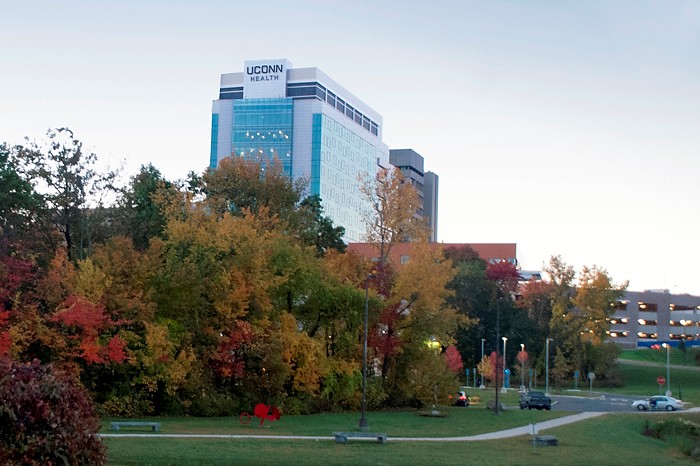
New UConn Health hospital tower as it appears Oct. 15, 2015 (Janine Gelineau/UConn Health)
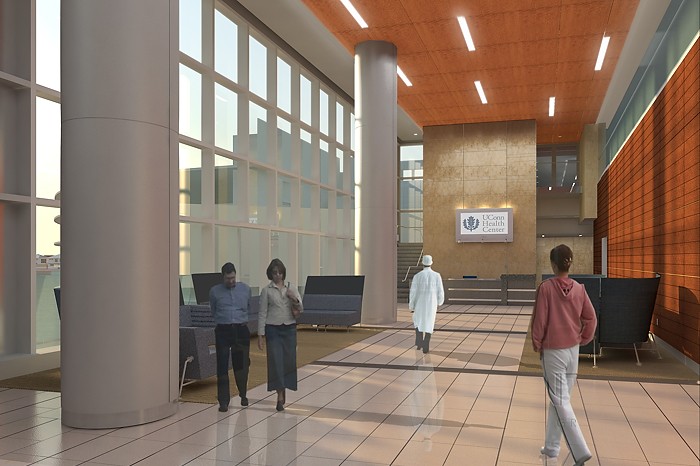
The main lobby of the new hospital tower as it appears on October 28, 2015. (Chris DeFrancesco/UConn Health Photo)
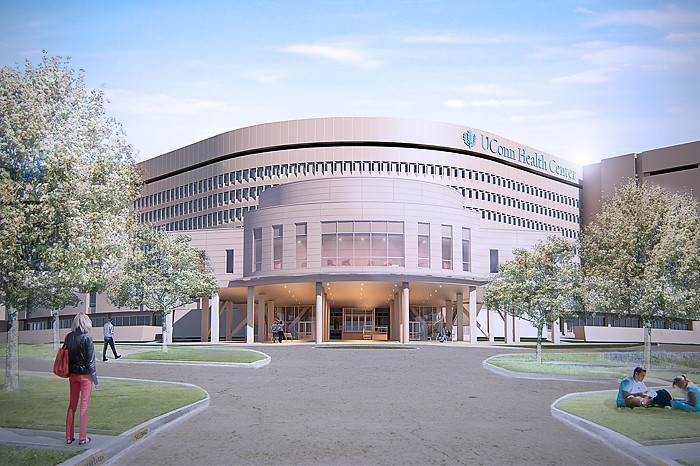
Rendering of the main lobby of the new hospital tower
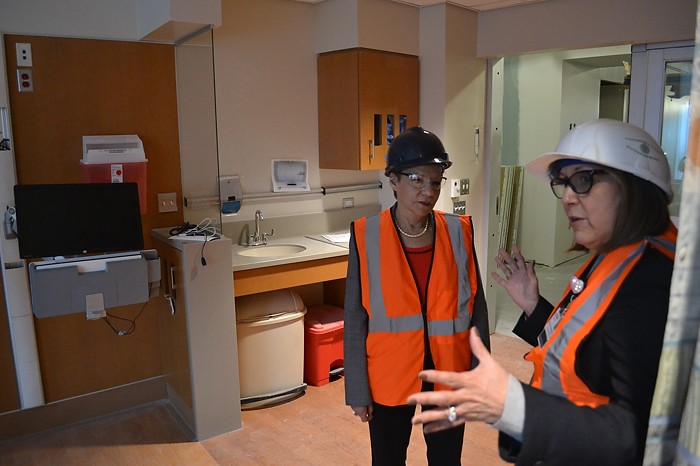
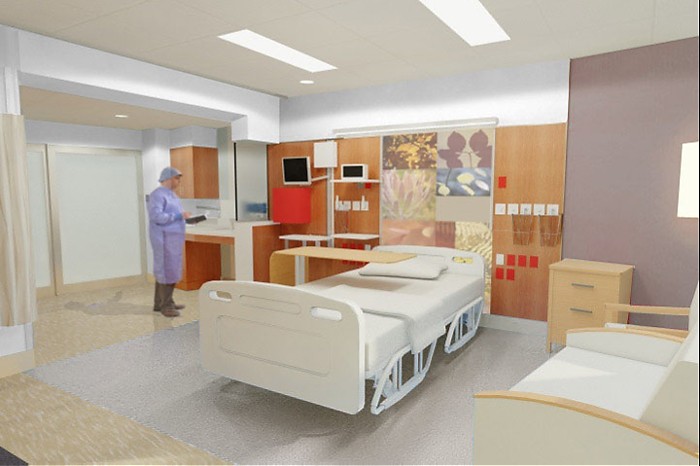
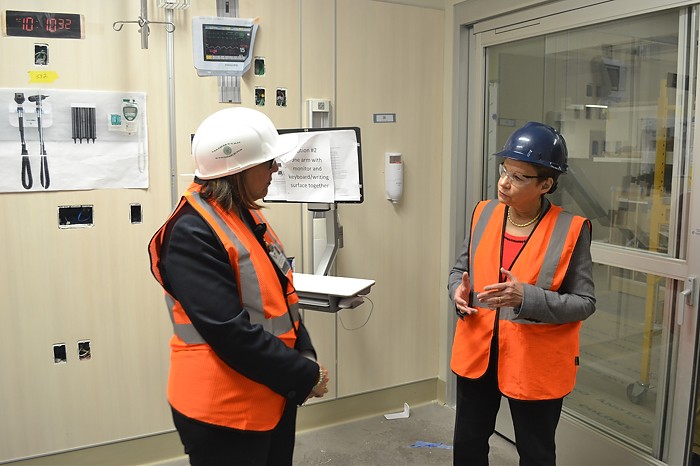
John Dempsey Hospital CEO Anne Diamond (right) shows Cheryl Chase of the UConn Health Board of Directors the spacious single-occupancy patient rooms the new hospital tower will offer. (Chris DeFrancesco/UConn Health Photo)
Rendering of an inpatient room in the new hospital tower
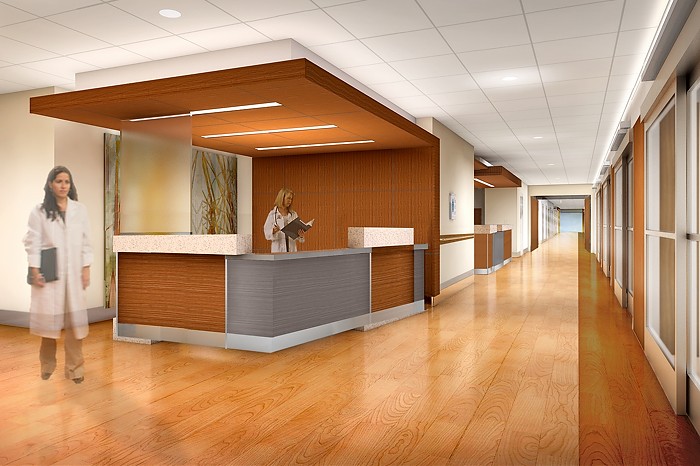
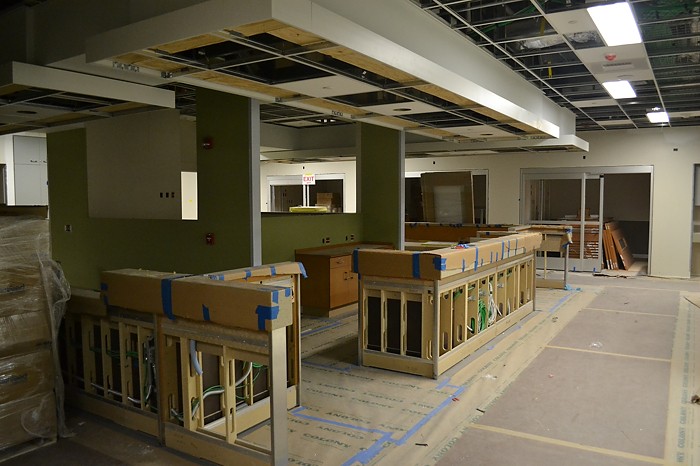
A future nurse's station on one of the new hospital floors as it appears on October 28, 2015. (Chris DeFrancesco/UConn Health Photo)
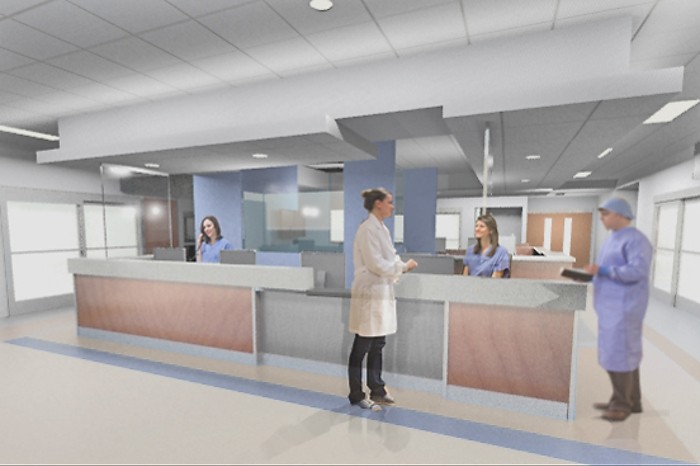
Rendering of an inpatient floor in the new hospital tower
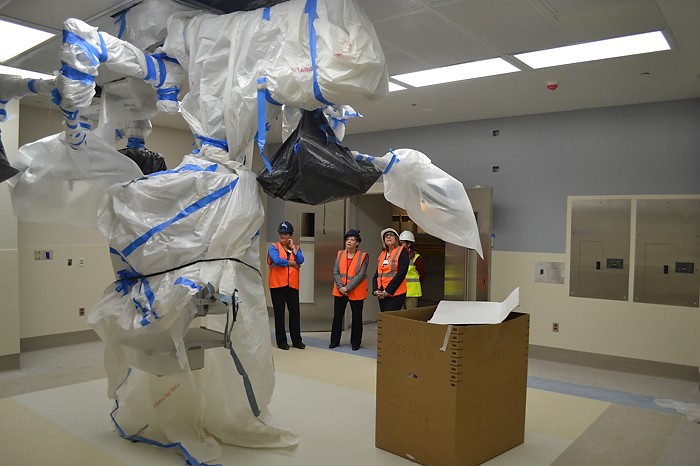
The operating rooms in the new hospital tower will be significantly larger. (Chris DeFrancesco/UConn Health Photo)
The view of lower campus from the second floor of the new hospital tower as it appears on October 28, 2015. (Chris DeFrancesco/UConn Health Photo)
Cheryl Chase (right) and Anne Diamond discuss the features of the large patient rooms in the new hospital tower's emergency department on October 28, 2015. (Chris DeFrancesco/UConn Health Photo)
A future emergency department nurse's station as it appears in the new hospital tower on October 28, 2015. (Chris DeFrancesco/UConn Health Photo)
Rendering of an emergency department nurse's station in the new hospital tower
Rendering of the academic entrance
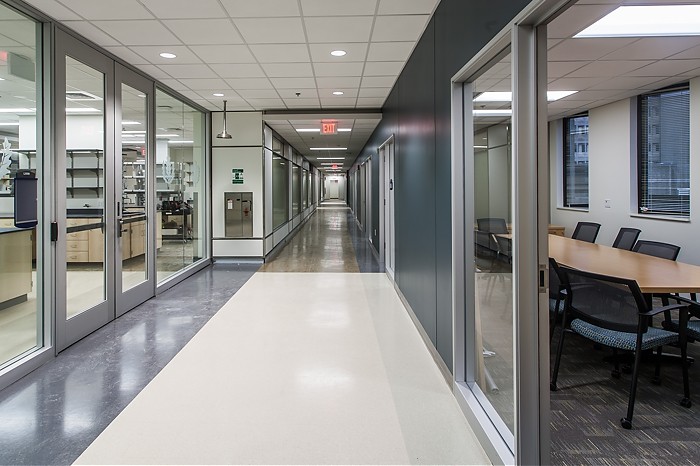
The renovated L building features spacious labs on one side of the corridor and conference space on the other. (Photo by Bernstein Associates for UConn Health)
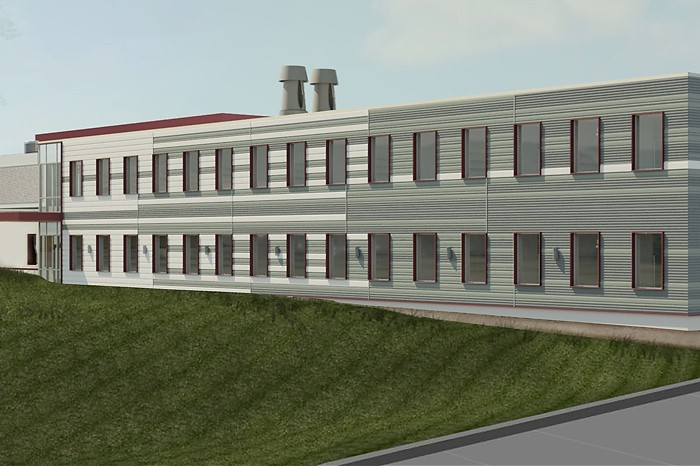
Rendering of incubator lab addition at the Cell and Genome Sciences Building
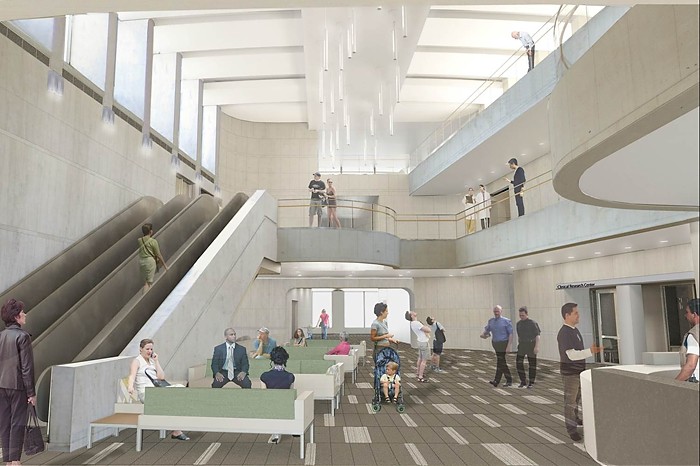
Rendering of proposed renovations to the existing UConn Health Main Lobby providing new entrance to renovated dental clinics and cardiology practice
It’s only a matter of months now until UConn Health’s new hospital tower changes from a construction worksite to a building ready for occupancy.
The new building, which will feature 169 single-bed inpatient rooms, is widely considered to be the centerpiece of UConn’s share of Gov. Dannel P. Malloy’s Bioscience Connecticut initiative, an $864 million package of state investments designed to be a catalyst for economic growth in the health care and biomedical research industries. As of Sept. 1, the total number of construction jobs associated with Bioscience Connecticut was 4,540.
Clinical staff and administration have started touring parts of the building and seeing finished mock-ups of patient rooms, emergency department bays and operating rooms. The new tower will include:
An expanded emergency department
Four 28-bed units that will house surgery, orthopedic, oncology and medical patients
A 28-bed intensive care unit with expanded surgical, medicine and neurology critical care services
A 29-bed intermediate unit
Once the new tower construction is complete and the hospital opens, there will be a second phase of work to make the final connections to the main building through the existing emergency department. There will also be additional exterior site work to complete near the existing ED entrance that cannot be done until after the ED moves.
Outpatient Pavilion
The UConn Health Outpatient Pavilion has one final milestone ahead: the establishment of a women’s health center on the top floor, with services including a women’s radiology center, obstetrics and gynecology, maternal-fetal medicine, and advanced women’s ultrasound.
The first practices moved in to the new building in February, and by early summer floors 1 through 7 were operational. The result has been the movement of nearly all outpatient services into a single place on the lower campus, in a patient-friendly environment, with convenient parking in a connected garage.
With its abundance of natural lighting, energy efficient design, and shower facilities to encourage employees to bike to work, the pavilion is on its way to earning Leadership in Energy and Environmental Design (LEED) Silver certification from the U.S. Green Building Council. Additionally, the Connecticut Green Building Council has just named the building the winner of its 2015 Institutional Award of Merit.
Academic Building
Construction is well underway at the academic entrance, where a modernization and expansion of space for the medical, dental and graduate schools is taking place. Bioscience Connecticut calls for a 30 percent increase in class sizes and the addition and renovations will provide space to support this growth. UConn Health held a groundbreaking on convocation day. The academic entrance will remain a construction site through May.
L Building
Though less visible than the projects already mentioned, a rebuild of UConn Health’s laboratory space in what’s known as the L Building is a significant portion of the Bioscience Connecticut construction. The renovations are being accomplished under two separate projects. Project 1 started in late 2012 and is complete. Project 2 is scheduled to be complete by early 2017, at which time UConn Health will boast modern lab layouts that are open plan and conducive to collaborative research.
Cell and Genome Sciences Building
The addition of incubator laboratory space continues at the Cell and Genome Sciences Building, 400 Farmington Ave., which will enable UConn Health to attract more biotech startups. It’s another aspect of the vision of Bioscience Connecticut to create a worldwide biomedical research/biotech hub in the state. This project is scheduled for completion by the end of November 2015.
Clinic Building
The design work is complete for major renovation to the Dental School clinical space, the Pat and Jim Calhoun Cardiology Center, and the Main Lobby. This phased renovation will take more than two years to complete but when finished will provide state-of-the-art dental clinical space and an expanded cardiology center with additional exam space. The Main Lobby will also be given a significant update that enhances the patient flow and provides easy access to the renovated spaces. The renovations are expected to begin in the second quarter of 2016.


 The Thanksgiving Feast