HealthONE Ramping up Testing, 8 Months From Go-Live

August 31, 2017

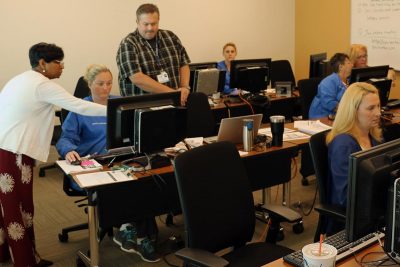
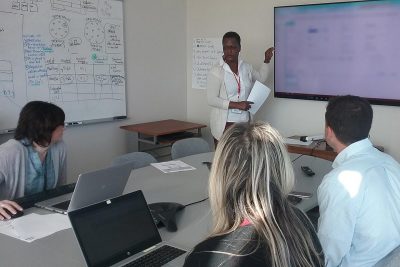
HealthONE analysts from the OpTime, Anesthesia, and Inpatient teams work together to execute a script. (Photo by Ethan Giorgetti)

The employees and consultants who are overseeing UConn Health’s conversion to a modern electronic medical record system are now well into what is probably the most important stretch of the testing phase.

The second of five planned rounds of integrated testing is underway. If you liken it to a theater production, the show has been cast and the actors know their lines, and now they’re starting to rehearse together on stage.

In this case, the stage is the fourth floor of the Connecticut Tower, which has been converted into an area designated for this purpose through the end of December. Integrated testing started July 31 and represents the largest part of the overall testing phase.

“Each analyst represents a different piece of the system,” says HealthONE business system analyst Margo Higginbotham. “They’ve kind of been in their little silos for a while now. When we say integrated, it’s them now coming together and saying, ‘Oh, so when I do that, it affects you.’ That’s the whole point of this, to identify defects now so next time we run them, we’ll see if it makes it through.”

There are nearly 150 scripts, or workflows, to test over the next three months to determine which pieces of the process are working properly. These scripts represent approved current and future state patient workflows and how HealthONE will handle them, for example from registration to admittance to recovery to medications to discharge and billing.

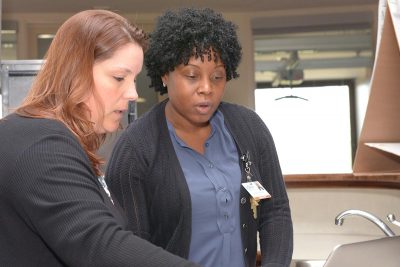
Trisha Faraday (left) and Donatienne Noel help facilitate integrated testing of HealthONE workflows. (Photo by Ethan Giorgetti)

“Now is the time to find those defects in between each of their applications, or something that would have executed in one system but isn’t working as planned when integrated with another application,” says HealthONE application architect Trisha Faraday. “Those are the defects that we’re now finding.”

During the first three weeks, or Round 1, the analysts ran 95 scripts, 34 of which passed. They expect to execute most of the rest during Round 2, which started this week. Some of the scripts that didn’t pass in Round 1 are back in Round 2 to see if the defects have been successfully resolved. Others need more time to be fixed and will return to testing in Round 3.

“Testing it now in this environment is where you’re going to be able to fix it with the least amount of impact to the user,” Faraday says. “This will make things run smoothly and efficiently when we’re ready to present it to the end users during the workflow walkthrough this fall.”

A better than 33 percent pass rate far surpassed expectations for the first round.

“We got off to a great start,” Higginbotham says. “Round 1 confirmed that our adoption, build, and testing efforts so far have been successful. It also helped us zero in on early opportunities for improvement.”

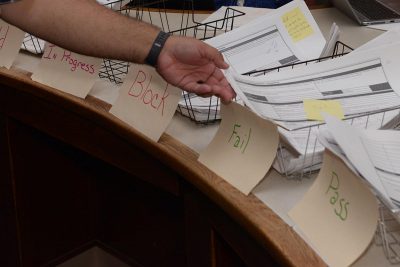
HealthONE will take a lot of paper out of the electronic medical records system. But during integrated testing, each script is a multi-page printout of a workflow that the analysts follow and then categorize. (Photo by Ethan Giorgetti)

Faraday, Higginbotham, and Donatienne Noel, a consultant with experience with Epic, the HealthONE software vendor, make up the quality assurance group, which facilitates the integrated testing. They serve as a support system to the analysts.

“The testers are executing their scripts diligently; and are seeing the bigger picture of the application and how it is fully integrated,” Noel says. “The practice of testing is allowing them to verify whether the actual build matches the expected results and to ensure that software system defects are at a minimum prior to go-live.”

The overall testing phase is scheduled to run through the end of March and overlap with end-user training, which is scheduled to start Feb. 1. The go-live date is April 28.

“Probably the most encouraging thing is how well the analysts work together in the testing room,” Faraday says. “They go in there with a great mindset of, ‘We’re going to get this script done,’ and they really work as a team.”

More information about HealthONE is available at uconnhealthexpress.uchc.edu/emr.

Global Health Homecoming

Many of our UConn medical and dental students spent part of their summer abroad providing medical care to those with few resources and learning valuable lessons about human resilience. Last night, some of them gathered for a “Global and Community Health Homecoming” to share their stories — and pictures — with their classmates.

Looking at Us: Dig This, Carol Underwood

August 30, 2017

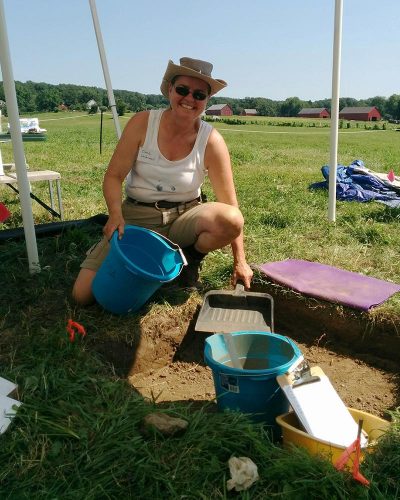
Carol Underwood helps unearth artifacts at an archaeological dig in Glastonbury. (Photo provided by Carol Underwood)

Carol Underwood spent a week this summer on an official dig with state archaeologist Brian Jones. Carol lives in Bloomfield and has been with UConn Health for five years. When she’s not unearthing artifacts, she’s working in the Information Technology Department as an application architect and Oracle database administrator. The official dig she participated in was at a large buried farm complex in Glastonbury associated with Lt. John Hollister of Glastonbury that dates back to the mid-17th century.

What did you find?

Artifacts like rusty iron nails, bits of brick, glass, bone, teeth, fish scales, charcoal, chert, flint, clay pipe stems and bowls, pottery both glazed and earthenware, snails. I was not lucky enough to find the native beads and points that were unearthed. I exposed a “feature” which was a large stain in the dirt 30 centimeters down that indicated a support post for the house had been there.

What is the significance?

This is arguably the most important historic period archaeological site to be identified in the state of Connecticut. The site documents an especially poorly understood period of colonial history as the first English settlers of the Connecticut River Valley adjusted to a new way of life.

How did you become interested and get involved?

I always liked dirt, digging, history and databases. All are good qualities to have in an archaeologist. Decades ago I wrote to then state archaeologist Nicholas Bellantoni about his work on vampires in New England. He wrote me back and invited me to come on a dig, so I had been thinking about this for a long time.

Carol Underwood

Favorite musician:
Dixie Chicks/Natalie Maines

Favorite place to visit:
Acadia National Park (Seawall, Thunder Hole)

Person you’d like to meet:
Former Alabama Gov. George C. Wallace. During his final years, he publicly recanted his racist views and asked for forgiveness from African Americans. I would like to talk to him about that process.

Favorite sports team
UConn women’s basketball

What was a typical day like?

Each day was a day of hard labor surrounded by beautiful farms and horses. I would arrive at the Park & Ride at 8:45 a.m. and meet up with other crew members. We would carpool to the farm, then stroll through the horse pasture down to the dig site. We erected a tent city to protect us from the sun. We would start right in digging our area that was carefully marked out. Precise levels of dirt were removed and each bucket sifted. Artifacts found were placed into plastic bags marking site, quadrant, quad, level and my initials. It was dig – sift, dig – sift cycle all day long till 3 p.m. If someone found a cool artifact we would do show and tell. I went home tired, dirty and exhilarated.

What surprised you on this dig?

Ground-penetrating radar (GPR) technology was used to find the original farmstead. The radar also showed three wigwams, which may be the first archaeological evidence of cohabitation between early colonists and Native Americans.

Also, one day, to my surprise, the now-retired Dr. Nicholas Bellantoni showed up. I told him about the letters we wrote to each other many years ago then said, “I’m here!” I got to work with Dr. Bellantoni and he was finding all the good stuff like native beads.

Learn more about the Connecticut Archaeology Center at www.cac.uconn.edu/osa.html.

Bruce Metz Named CIO

August 24, 2017

Bruce Metz Named UConn Health CIOUConn Health welcomes Bruce Metz as chief information officer starting Sept. 11.

“UConn Health has a wealth of opportunity and extraordinary capabilities including possibilities presented by the one UConn model.  I am very excited to be joining such a talented team and look forward to helping the organization achieve even greater levels of excellence in research, teaching, and clinical care by capitalizing on advances in technology,” said Metz.

With experience at academic institutions like Tufts, Rider, and Princeton, he has twice led large organizational electronic health record transformations, once at Thomas Jefferson in Philadelphia, and more recently bringing EPIC to Lahey Health in Burlington, Massachusetts where he served as senior vice president and chief information officer.

In this role, he will report to leadership both at the University and UConn Health.

“In our model, it’s essential to have someone with the kind of experience to navigate all the challenges and deliver that reliable, high-quality product for the thousands of users – staff and patients – who rely on it every day,” commented Dr. Andy Agwunobi, EVP, and CEO of UConn Health. “I am therefore extremely excited that Bruce will be joining us.”

“As the first UConn Health CIO under our one university movement, I know Bruce will help us find ways to work together, leverage learning, find opportunity and start us down a path where collaboration makes us stronger together than we could be independently,” said Michael Mundrane, Vice Provost and CIO, University of Connecticut.

Metz received a B.S. degree in industrial and management engineering from Columbia University, and an M.A. in organizational development and Ph.D. in applied psychology from New York University.

Metz assumes duties from Denise Purington who has acted as interim CIO since December. Denise will stay engaged as long as needed to support a smooth transition.

“UConn Health leadership is grateful to Denise for the leadership, perspective, and stability she brought to the organization under her leadership,” added Dr. Agwunobi.

UConn Health September 2017 Programs, Events

August 15, 2017

Here is a list of UConn Health programs scheduled for September and early October 2017. This information will be updated with any additions or other schedule changes. (Updated 9/18)

Living Well With Epilepsy: A Support Group for Young Adults
Saturday, Sept. 2, noon to 1:30 p.m.
, UConn Health Outpatient Pavilion, 2nd Floor, Large Conference Room S2010

The Epilepsy Foundation of Connecticut, in partnership with the UConn Health Department of Neurology, offers a support group for young adults who live with epilepsy. This group is open to those aged 18 to 30 who would like to join others to share experience, gain peer support, and learn together about epilepsy and overcoming its challenges to live well. The group generally meets on the first Saturday of the month. Please call 860-346-1924 or email manzelone.efct@sbcglobal.net for more information.

Bladder Cancer Support Group
Saturday, Sept. 2, 2 to 3 p.m.
, UConn Health, Onyiuke Dining Room
Patients, family members and caregivers (not limited to UConn Health patients) are invited to join others whose lives have been touched by bladder cancer. This support group, established in partnership with the Bladder Cancer Advocacy Network, usually meets on the first Saturday of the month and is the only group of its kind in New England. Call 888-901-BCAN for more information.

UConn Health Epilepsy Support Group
Wednesday, Sept. 6, 6:30 to 8 p.m.
, UConn Health Outpatient Pavilion, 2nd Floor, Large Conference Room S2010

The UConn Health Department of Neurology invites those with epilepsy to a monthly group meeting surrounding life with epilepsy. Discussion topics include coping methods, support systems, and resources. The group generally meets on the first Wednesday of the month. Please call 860-679-3186 for more information.

Free Hospital Maternity Tours
Saturday, Sept. 9, 2 p.m.
, UConn Health, University Tower lobby
A representative will guide you through labor and delivery, postpartum, and the nursery at the UConn John Dempsey Hospital. Children and grandparents are welcome. Call 800-535-6232 to register or for more information.

Childbirth Preparation Class
Wednesday, Sept. 13, 6 to 10 p.m.
, UConn Health Outpatient Pavilion, 3rd floor conference room S3301
This one-day class covers anatomy and physiology of pregnancy and labor, emotions of pregnancy, nutrition, fetal growth and development, comfort measures for labor, working with unexpected events in labor, cesarean delivery, and practice of relaxation and breathing techniques for labor. Class size is limited to eight couples. Remember to bring two pillows and wear comfortable clothing. Light snack is provided. Fee is $100. Call 800-535-6232 or 860-679-7692 to register or for more information.

Celiac Disease Nutrition Class
Monday, Sept. 18, 8 to 9 a.m., UConn Health Outpatient Pavilion
A registered dietitian leads a discussion for those with celiac disease or non-celiac gluten sensitivity. This program now is scheduled to meet the third Monday of the month. A physician’s referral is required. Fee is $20. Call 860-679-3245 more information.

New 6-week “Ready to Lose” Weight Management Program Starts
Tuesday, Sept. 19, 5 to 6 p.m.
, UConn Health Outpatient Pavilion, 2nd floor east
The introductory session is followed by five weekly sessions through Tuesday, Oct. 24, that include a weigh-in, discussion of progress, and a timely nutrition topic such as eating out strategies, cooking light and right, emotional eating, exercise and activity, and smart shopping. Registration fee is $70, $50 for past participants. Call 800-535-6232 or 860-679-7692 for more information.

Breast-feeding Class
Wednesday, Sept. 20, 7 to 9 p.m.
, UConn Health Outpatient Pavilion, 3rd floor conference room S3301
A certified lactation consultant leads a discussion of topics including the benefits of breast-feeding, how to get started, and how the rest of the family can help the breast-feeding mother as well as how to continue breast-feeding and working. Fee is $25 per couple. Call 800-535-6232 to register or for more information.

Living With Heart Disease Meeting
Thursday, Sept. 21, 11 a.m. to noon
, UConn Health, University Tower, 2nd floor conference room

Men and women affected by heart disease meet on the third Thursday of the month to discuss post-diagnosis topics such as prevention and wellness, social and emotional support, heart-healthy recipes, coping strategies and resources. Please call Sue at 860-679-3633 for more information.

Breast Cancer Support Group
Thursday, Sept. 21, 7 to 8 p.m.
, UConn Health, Onyiuke Dining Room
This is a support group intended for women under the age of 45 who’ve been diagnosed with non-metastatic breast cancer. Women at any point in their cancer survivorship journey are welcome. Meetings are the third Thursday of the month. To register or more information, call 860-679-7820 or email tillinghast@uchc.edu.

Infertility Peer Support Group
Thursday, Sept. 21, 7 p.m.
, Center for Advanced Reproductive Services, 2 Batterson Park Road, Farmington.

The Greater Hartford chapter of RESOLVE, a national nonprofit resource for those facing the challenges of infertility, offers support, information and confidential, informal, peer-led discussions on the third Thursday of the month. To learn more or to check for weather-related cancellation, call 860-523-8337.

Free Workshop: “Things to Consider Before Joining a Research Study”
Monday, Sept. 25, 5 p.m.
, UConn Health, Onyiuke Dining Room

The UConn Health Human Subjects Protection Office offers an educational session about the rights and responsibilities of participants in research projects on the last Monday of the month. Registration is required: 860-679-8802 or cagganello@uchc.edu.

Stroke Survivor Group
Wednesday, Sept. 27, noon to 1 p.m.
, UConn Health Outpatient Pavilion, 3rd floor
The UConn Health Stroke Center invites stroke survivors, families and caregivers to a monthly group meeting to discuss topics such as prevention, coping methods, support systems, rehabilitation tips, resources, and promoting independence. The Stroke Survivor Group generally meets on the fourth Wednesday of the month. Call 860-679-4846 for more information.

Free Hospital Maternity Tours
Saturday, Sept. 30, 2 p.m.
, UConn Health, University Tower lobby
A representative will guide you through labor and delivery, postpartum, and the nursery at the UConn John Dempsey Hospital. Children and grandparents are welcome. Call 800-535-6232 to register or for more information.

UConn Health Epilepsy Support Group
Wednesday, Oct. 4, 6:30 to 8 p.m.
, UConn Health Outpatient Pavilion, 2nd Floor, Large Conference Room S2010
The UConn Health Department of Neurology invites those with epilepsy to a monthly group meeting surrounding life with epilepsy. Discussion topics include coping methods, support systems, and resources. The group generally will meet on the first Wednesday of the month. Please call 860-679-3186 for more information.

(Updated 9/18–Rescheduled to Oct. 25)
Childbirth Preparation Class
Saturday, Oct. 7, 8:30 a.m. to 12:30 p.m.
, UConn Health Outpatient Pavilion, 3rd floor conference room S3301
This one-day class covers anatomy and physiology of pregnancy and labor, emotions of pregnancy, nutrition, fetal growth and development, comfort measures for labor, working with unexpected events in labor, cesarean delivery, and practice of relaxation and breathing techniques for labor. Class size is limited to eight couples. Remember to bring two pillows and wear comfortable clothing. Light snack is provided. Fee is $100. Call 800-535-6232 or 860-679-7692 to register or for more information.

Living Well With Epilepsy: A Support Group for Young Adults
Saturday, Oct. 7, noon to 1:30 p.m.
, UConn Health Outpatient Pavilion, 2nd Floor, Large Conference Room S2010
The Epilepsy Foundation of Connecticut, in partnership with the UConn Health Department of Neurology, offers a support group for young adults who live with epilepsy. This group is open to those aged 18 to 30 who would like to join others to share experience, gain peer support, and learn together about epilepsy and overcoming its challenges to live well. The group generally meets on the first Saturday of the month. Please call 860-346-1924 or email manzelone.efct@sbcglobal.net for more information.

Bladder Cancer Support Group
Saturday, Oct. 7, 2 to 3 p.m.
, UConn Health, Onyiuke Dining Room
Patients, family members and caregivers (not limited to UConn Health patients) are invited to join others whose lives have been touched by bladder cancer. This support group, established in partnership with the Bladder Cancer Advocacy Network, usually meets on the first Saturday of the month and is the only group of its kind in New England. Call 888-901-BCAN for more information.

Directions to UConn Health are available at http://bit.ly/get2uch.

Behind the Scenes: Crucial Work on 3rd-party Applications

August 10, 2017

Christopher Carroll, Director, Ancillary Applications, UConn HealthONE (Photo by Chris DeFrancesco)

The HealthONE Epic software does not work by itself, it relies on a number of third-party systems and must integrate with these non-Epic systems.

Between existing and new systems, the HealthONE directors, with support from Procurement Operations and Contracts (and sometimes Epic), had to negotiate contracts with about 70 vendors. We’re close to having these contracts finalized, which is a major milestone.

More than 40 of the 70 systems required test systems to be in place. This would allow the interfacing between Epic and the third-party system in a non-production environment, while the current production systems were left intact.

Once the contracts were signed, we were able to get started on many mini-projects. This involves project teams including:

UConn Health One badge

  • Departmental subject matter experts (SMEs)
  • Server team
  • Desktop team
  • Networking
  • Project managers
  • Analysts
  • Clinical engineers
  • Integration specialists
  • Vendors

When a test system was needed, we assessed and ordered the hardware, and put a test system in place. When necessary, we initiated project upgrades.

What Do They Mean by That?

See this guide to HealthONE terms.

It’s a complex task to move through these steps. If information is to flow accurately between HealthONE and the third-party application, often there is “translation” work involved, since architecture in each application is different. This translation of the data requires considerable analysis. We built and tested interfaces, with a deadline for all the test systems and functionally tested interfaces to be ready at the start of the Integrated testing, July 31.

All this was done while balancing the other normal hospital functions, other Epic-related SME responsibilities, Epic build, and testing. SMEs from the departments have been, and will continue to be, involved in validation of the interfacesd test results. Validation will continue as the project progresses.

As you can see, it is a true team effort across UConn Health. Just as “Rome was not built in a day,” nor will be the HealthONE project.

–Christopher Carroll, Director, Ancillary Applications, UConn HealthONE

Watch for additional HealthONE updates in Lifeline, in the Pulse, and at uconnhealthexpress.uchc.edu/emr.

App Enables Real-time Tracking of New Campus Shuttles

August 3, 2017

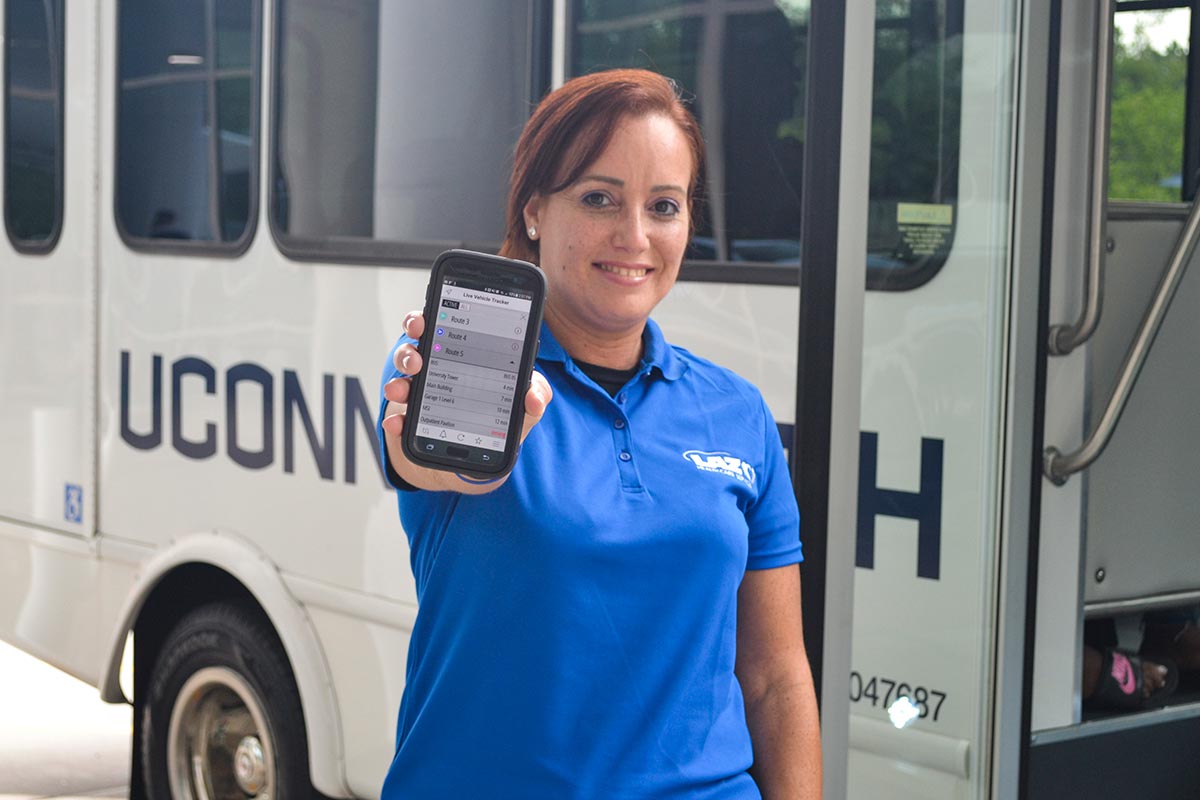
LAZ Parking shuttle driver Sandra Huertas shows how live vehicle tracking is now available on the UConn Health campus shuttle system. (Photo by Kristin Wallace)

You may have noticed something different about the campus shuttles at UConn Health.

The buses have digital route and destination signs and are branded with the UConn Health logo. The drivers wear blue uniforms.

Less obvious, the buses also have GPS monitoring. And that enables a feature that’s new to UConn Health shuttle passengers.

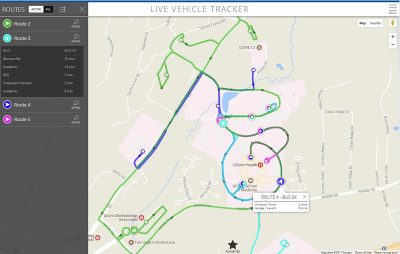
“We are excited to roll out a mobile phone app and desktop link that track the shuttles along their routes and display the wait time between shuttle stops,” says Allan Peterson, director of Parking, Transportation and Event Services.

UConn Health’s campus shuttle system is now available on the Ride Systems app, accessible by smart phone or desktop.

LAZ Parking is the new campus shuttle provider. The routes and schedules remain the same and are now accessible, along with the buses’ locations in real time, through the Ride Systems app. Ride Systems is available on both iPhone and Android platforms. Desktop users also can see the live vehicle tracker and route details at www.uconnhealthshuttles.com.

“LAZ brings some other great enhancements to our shuttle service, including new, more fuel-efficient vehicles,” Peterson says. “The drivers undergo a training program focused on both safe operating procedures and customer service skills.”

Already the contractor for UConn Health’s parking garages and valet service, LAZ became the campus shuttle service provider July 1.

End User Acceptance Application Testing Wrapping Up

July 27, 2017

Nurses and medical assistants serve as subject matter experts to test Lab Orders at the Point of Care workflows. (Photo by Ethan Giorgetti)

HealthONE is drawing lots of attention across the organization as providers and employees obtain their first hands-on view of Epic workflows. End User Acceptance Application Testing (EUAT) is in full swing as HealthONE teams are facilitating testing of specific workflows within their build with their subject matter experts (SMEs). SMEs are active participants to test-drive workflows such as:

  • Office Visit
  • In Office Procedure Visit
  • Clinical Support Visit
  • Lab Orders at Point of Care
  • Medication Reorder Request
  • My Chart e-Check-In
  • My Chart Med Renewal Request
  • Ortho Casting
  • Ortho Injection Visit
  • Ortho Office Visit with X-Ray
  • Healthy Planet Population Outreach
  • Healthy Planet Chronic Care Management


What Do They Mean by That?

See this guide to HealthONE terms.

By the end of the month, the Ambulatory team will have held 55 script review sessions across their applications with audiences of up to 10 SMEs.

“Users attending ambulatory testing so far have been very pleased,” says Ambulatory Director Kathy Noel. “They expressed appreciation for the opportunity to test-drive HealthONE with UConn Health decisions built in. The common theme expressed was a release of anxiety and ‘it seems easier than I thought it would be.’”

A script is a series of steps that mimic workflows. Scripts are used to help determine whether an application will work as intended.

Testing of Health Information Management applications (Photo by Chris DeFrancesco)

In the world of Access and Revenue Cycle Applications, nine sessions are covering more than 20 scripts for workflows including:

  • Payment Posting
  • Hospital Coding
  • Admitting Patients
  • Patient Appointments
  • Referrals
  • Patient Transport
  • Patient Check-in
  • Charge Review

“Thus far our SMEs and end users are excited and are telling us they’re happy with the workflow and functionality,” says Access and Revenue Cycle Director Carolyn Orrell.

The Ancillary applications team has been testing 20 scripts and is also generating valuable feedback.

“It’s providing a crucial clinical perspective on real work needs that may,” says Ancillary Director Christopher Carroll. “For instance, latex allergy: We need to make sure that latex allergy patients are clearly identified, even if this is not caught until the last minute. The supplies will need to be updated to accommodate.”

And Clinical Applications Director Liz Zibell reports the inpatient teams, including Willow (pharmacy), Clinical Documentation, ASAP (emergency department) and Orders, had 17 scripts to review. Their SMEs include physicians, nurses, and representatives from pharmacy, case management, respiratory, physical therapy, and dietary.

“They all had active roles in reviewing workflows pertinent to their daily workflows,” Zibell says. “We had great input for some updates in workflow process, but more importantly our end users seemed to all echo very positive feedback on the build and design of HealthONE to date. All agreed that they saw many improvements available for inpatient care coming in April 2018.”

More information about HealthONE is available at uconnhealthexpress.uchc.edu/emr.

HealthONE: 9 Months Away and Counting

July 20, 2017

(Getty Images)

The group tasked with implementing UConn Health’s new electronic medical record system, HealthONE, is preparing to start another major step.

The testing phase, which got underway in May, moves into the first of five rounds of integrated testing starting July 31. In the 18 weeks that follow, analysts will test “integrated scripts” to uncover potential defects. The scripts, which mimic current workflows, practices and processes, serve as a way to ensure processes within HealthONE’s clinical, patient access, and revenue cycle applications will work when the system goes live.

“It’s known as integrated testing because it verifies that workflows affecting multiple departments, applications or interfaces can be carried out successfully in HealthONE and across all the external systems we interface with,” says Bryan Kerr, interim assistant vice president for HealthONE.

UConn Health One badge

Bringing HealthONE online is a six-phase undertaking. Testing is the third, and longest, phase. Other types of testing already have started. The first round of what’s known as “end-user testing,” in which health care providers and other subject-matter experts try out the system and provide feedback, runs through next week. Testing is scheduled to run into next spring and overlap with the training phase.

“We are nine months away from go-live, and we’re right on track,” says Denise Purington, interim chief information officer. “We continue to receive satisfactory evaluations and are hitting critical milestones.”

HealthONE Training

Upcoming Information Sessions

Main Building
Food Court Lobby

  • Tuesday, July 25
  • Thursday, July 27
  • Tuesday, Aug. 8

Outpatient Pavilion
5th Floor, Cafeteria

  • Tuesday, July 25
  • Thursday, July 27
  • Tuesday, Aug. 8
  • Thursday, Aug. 10

All times 11 a.m. to 1 p.m.


UConn Health gets a monthly progress report from the HealthONE vendor, Epic, which provides the software, training and support.

Looking Ahead

There will be information sessions about HealthONE training for inpatient and outpatient staff starting next week.

HealthONE is looking for staff with the appropriate skills to be a member of the HealthONE Credentialed Trainer group. More information about this role is available at one of the training information sessions or by emailing kirobinson@uchc.edu.

Additionally, a list of frequently asked questions on HealthONE training is now available.

The HealthONE website is being updated and will have more frequent and timely updates as the April 28, 2018, go-live date nears.

In the coming weeks, UConn Health IT staff will start installing computers, monitors, and other hardware in departments needing technology upgrades for HealthONE to work optimally. IT will work with managers on scheduling to minimize disruptions.

PAWS Award Winners July 2017

June 20, 2017 UConn Health Paws Award RecipientsJune 20, 2017 UConn Health Paws Award Recipients
Human Resources is pleased to announce the July 2017 PAWS award recipients. (Part of a team,  Awesome attitude,  Wonderful work ethic, Superior Service).

Vicky Aldrich, Department of Social Work
Mayra Cagganello, Human Subject Protection/IRB
Krystyna Dzierlatka, Surgery/Orthopaedics Unit
Sarah Heald, Medical/Surgical/Oncology Unit
Barbara Laskey, Dental Financial Services
Kasheene Levett, CMHC – Garner (Administration)
Emily Placeres, UMG – Internal Medicine Associates (West Hartford)
Dr. Bernardo Rodrigues, Neurology
Ania Scott, UMG – Surgery/Ophthalmology
Christine Urban, UMG – Storrs (Administration)
Jennifer Welch, UMG – Internal Medicine Associate (West Hartford)

TEAMS
VAE GROUP   MEDICAL RESPONSE TEAM
Jill Alsgaard Intensive Care Unit Laura Contakis Intensive Care Unit
Janet  Annesi Respiratory Therapy Jessica Demarest Intermediate Unit
Rachel Crosby Epidemiology Jaroslaw  Dybinski Support Float Pool
Debapriya  Datta Pulmonary Susada  Inthavong Medicine 3 Unit
Kara Dazkevich Intensive Care Unit Ana Miranda Nursing Transportation
Michelle Delayo Intensive Care Unit Aadhar Patil, M.D. Resident
Nancy Dupont Epidemiology David  Policastro Intermediate Unit
Giselle Funchion Strategic Proj. & Clinical Sys. Sofia Talaniec Intermediate Unit
Aubrey Hepner Intensive Care Unit
Gillian  Kuszewski Pharmacy
Julie Laflamme JDH – Organization Staff Dev
Sandra Pilares Strategic Proj & Clinical Sys
Caryl Ryan Nursing Administration
Kimberly Silverman Rehab Services – Outpatient
Marie Sudsbury Epidemiology