Former Hartford Whalers and Hartford Yard Goats Visit UConn Health

July 20, 2017

To kick off Hartford Whalers’ Alumni Weekend last Friday, Yard Goats pitchers Ryan Castellani and Matt Pierpont, with former Hartford Whalers Bob Crawford, Mike Rogers, Grant Jennings, Dave Babych, and Norm Barnes visited hospital patients and also took the time to visit staff. Photos by Tina Encarnacion.

UConn Health August 2017 Programs, Events

July 19, 2017

Here is a list of UConn Health programs scheduled for August and early September 2017. This information will be updated with any additions or other schedule changes. (Last updated 8/11)

UConn Health Epilepsy Support Group
Wednesday, Aug. 2, 6:30 to 8 p.m.
, UConn Health Outpatient Pavilion, 2nd Floor, Large Conference Room S2010

The UConn Health Department of Neurology invites those with epilepsy to a monthly group meeting surrounding life with epilepsy. Discussion topics include coping methods, support systems, and resources. The group generally will meet on the first Wednesday of the month. Please call 860-679-3186 for more information.

Canceled 8/2
Breast Cancer Support Group
Thursday, Aug. 3, 6:30 to 7:30 p.m.
, UConn Health, Onyiuke Dining Room
This is a support group intended for women under the age of 45 who’ve been diagnosed with non-metastatic breast cancer. Women at any point in their cancer survivorship journey are welcome. Meetings are the first and third Thursday of the month. To register or more information, call 860-679-7820 or email tillinghast@uchc.edu.

Childbirth Preparation Class
Saturday, Aug. 5, 8:30 a.m. to 12:30 p.m.
, UConn Health Outpatient Pavilion, 3rd floor conference room S3301
This one-day class covers anatomy and physiology of pregnancy and labor, emotions of pregnancy, nutrition, fetal growth and development, comfort measures for labor, working with unexpected events in labor, cesarean delivery, and practice of relaxation and breathing techniques for labor. Class size is limited to eight couples. Remember to bring two pillows and wear comfortable clothing. Light snack is provided. Fee is $100. Call 800-535-6232 or 860-679-7692 to register or for more information.

Living Well With Epilepsy: A Support Group for Young Adults
Saturday, Aug. 5, noon to 1:30 p.m.
, UConn Health Outpatient Pavilion, 2nd Floor, Large Conference Room S2010

The Epilepsy Foundation of Connecticut, in partnership with the UConn Health Department of Neurology, offers a support group for young adults who live with epilepsy. This group is open to those aged 18 to 30 who would like to join others to share experience, gain peer support, and learn together about epilepsy and overcoming its challenges to live well. The group generally meets on the first Saturday of the month. Please call 860-346-1924 or email manzelone.efct@sbcglobal.net for more information.

Bladder Cancer Support Group
Saturday, Aug. 5, 2 to 3 p.m.
, UConn Health, Onyiuke Dining Room
Patients, family members and caregivers (not limited to UConn Health patients) are invited to join others whose lives have been touched by bladder cancer. This support group, established in partnership with the Bladder Cancer Advocacy Network, usually meets on the first Saturday of the month and is the only group of its kind in New England. Call 888-901-BCAN for more information.

Free Cosmetology Services for Cancer Survivors
Monday, Aug. 14, 1 to 3 p.m.
, UConn Health Outpatient Pavilion, 4th floor

“Look Good…Feel Better” is a free program to help improve the self-image and self-esteem of women experiencing appearance-related side effects from cancer treatment. During this hands-on workshop, a trained volunteer certified cosmetologist will teach women how to cope with skin changes and hair loss using cosmetic and skin care products donated by the cosmetic industry. Classes are offered every other month and are not limited to UConn Health patients. Please call 860-679-7820 to register (required).

Breast-feeding Class
Tuesday, Aug. 15, 7 to 9 p.m.
, UConn Health Outpatient Pavilion, 3rd floor conference room S3301
A certified lactation consultant leads a discussion of topics including the benefits of breast-feeding, how to get started, and how the rest of the family can help the breast-feeding mother as well as how to continue breast-feeding and working. Fee is $25 per couple. Call 800-535-6232 to register or for more information.

(Updated time 8/11)
Breast Cancer Support Group
Thursday, Aug. 17, 6:30 to 7:30 p.m. 7 to 8 p.m.
, UConn Health, Onyiuke Dining Room
This is a support group intended for women under the age of 45 who’ve been diagnosed with non-metastatic breast cancer. Women at any point in their cancer survivorship journey are welcome. Meetings are the first and third Thursday of the month. To register or more information, call 860-679-7820 or email tillinghast@uchc.edu.

Infertility Peer Support Group
Thursday, Aug. 17, 7 p.m.
, Center for Advanced Reproductive Services, 2 Batterson Park Road, Farmington.

The Greater Hartford chapter of RESOLVE, a national nonprofit resource for those facing the challenges of infertility, offers support, information and confidential, informal, peer-led discussions on the third Thursday of the month. To learn more or to check for weather-related cancellation, call 860-523-8337.

Free Hospital Maternity Tours
Saturday, Aug. 19, 2 p.m.
, UConn Health, University Tower lobby
A representative will guide you through labor and delivery, postpartum, and the nursery at the UConn John Dempsey Hospital. Children and grandparents are welcome. Call 800-535-6232 to register or for more information.

Celiac Disease Nutrition Class
Monday, Aug. 21, 8 to 9 a.m., UConn Health Outpatient Pavilion
A registered dietitian leads a discussion for those with celiac disease or non-celiac gluten sensitivity. This program now is scheduled to meet the third Monday of the month. A physician’s referral is required. Fee is $20. Call 860-679-3245 more information.

Stroke Survivor Group
Wednesday, Aug. 23, noon to 1 p.m.
, UConn Health Outpatient Pavilion, 3rd floor
The UConn Health Stroke Center invites stroke survivors, families and caregivers to a monthly group meeting to discuss topics such as prevention, coping methods, support systems, rehabilitation tips, resources, and promoting independence. The Stroke Survivor Group generally meets on the fourth Wednesday of the month. Call 860-679-4846 for more information.

Free Workshop: “Things to Consider Before Joining a Research Study”
Monday, Aug. 28, 5 p.m.
, UConn Health, Onyiuke Dining Room
The UConn Health Human Subjects Protection Office offers an educational session about the rights and responsibilities of participants in research projects on the last Monday of the month. Registration is required: 860-679-8802 or cagganello@uchc.edu.

Living Well With Epilepsy: A Support Group for Young Adults
Saturday, Sept. 2, noon to 1:30 p.m.
, UConn Health Outpatient Pavilion, 2nd Floor, Large Conference Room S2010
The Epilepsy Foundation of Connecticut, in partnership with the UConn Health Department of Neurology, offers a support group for young adults who live with epilepsy. This group is open to those aged 18 to 30 who would like to join others to share experience, gain peer support, and learn together about epilepsy and overcoming its challenges to live well. The group generally meets on the first Saturday of the month. Please call 860-346-1924 or email manzelone.efct@sbcglobal.net for more information.

Bladder Cancer Support Group
Saturday, Sept. 2, 2 to 3 p.m.
, UConn Health, Onyiuke Dining Room
Patients, family members and caregivers (not limited to UConn Health patients) are invited to join others whose lives have been touched by bladder cancer. This support group, established in partnership with the Bladder Cancer Advocacy Network, usually meets on the first Saturday of the month and is the only group of its kind in New England. Call 888-901-BCAN for more information.

UConn Health Epilepsy Support Group
Wednesday, Sept. 6, 6:30 to 8 p.m.
, UConn Health Outpatient Pavilion, 2nd Floor, Large Conference Room S2010
The UConn Health Department of Neurology invites those with epilepsy to a monthly group meeting surrounding life with epilepsy. Discussion topics include coping methods, support systems, and resources. The group generally meets on the first Wednesday of the month. Please call 860-679-3186 for more information.

(Canceled 8/2)
Breast Cancer Support Group
Thursday, Sept. 7, 6:30 to 7:30 p.m.
, UConn Health, Onyiuke Dining Room
This is a support group intended for women under the age of 45 who’ve been diagnosed with non-metastatic breast cancer. Women at any point in their cancer survivorship journey are welcome. Meetings are the first and third Thursday of the month. To register or more information, call 860-679-7820 or email tillinghast@uchc.edu.

Free Hospital Maternity Tours
Saturday, Sept. 9, 2 p.m.
, UConn Health, University Tower lobby
A representative will guide you through labor and delivery, postpartum, and the nursery at the UConn John Dempsey Hospital. Children and grandparents are welcome. Call 800-535-6232 to register or for more information.

Childbirth Preparation Class
Wednesday, Sept. 13, 6 to 10 p.m.
, UConn Health Outpatient Pavilion, 3rd floor conference room S3301
This one-day class covers anatomy and physiology of pregnancy and labor, emotions of pregnancy, nutrition, fetal growth and development, comfort measures for labor, working with unexpected events in labor, cesarean delivery, and practice of relaxation and breathing techniques for labor. Class size is limited to eight couples. Remember to bring two pillows and wear comfortable clothing. Light snack is provided. Fee is $100. Call 800-535-6232 or 860-679-7692 to register or for more information.

Directions to UConn Health are available at http://bit.ly/get2uch.

Looking at Us: Bryan Gran Elevates UConn Health’s Readiness

June 28, 2017

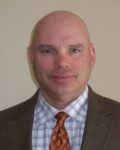
Do you know what to do in an emergency? Chances are, you don’t have the level of preparedness Bryan Gran has. Bryan joined UConn Health as our emergency management program specialist in December and oversees our emergency operations planning and programs to ready us to respond to hazards and emergencies. It’s a serious task for a serious man with a serious background that includes decades of service first in the military and then in the Connecticut Department of Emergency Management and Homeland Security.

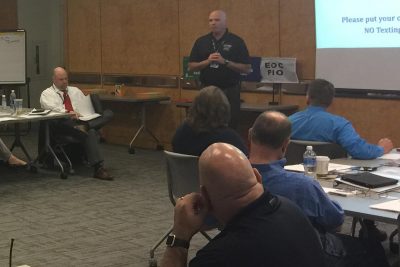
Bryan Gran presents at an emergency operations training session. (Photo provided by Bryan Gran)

You come with an impressive background. How has your experience shaped you into who you are today?

I have to say, first and foremost, that my experiences as a husband and father have shaped me into what I am today. Without my wife, Carol, of 35 years by my side I would not be where I am today both personally and professionally. I have spent my life in service starting with the military which I joined in 1981, at the age of 18. Through my 32 years of military service I saw the roles and missions of the military change from a Cold War emphasis to counter insurgency, nation building and now to the global war on terror. When September 11, 2001, happened, everything changed. As a member of the Connecticut National Guard our mission was immediately focused on the home front and homeland security; securing key infrastructure and protecting the citizens of Connecticut. Hurricane Katrina hit in 2005 and our mission scope included supporting emergency management efforts, something that has continued through hurricane Sandy and numerous other storms and hazards. For me it’s about the desire to protect and serve; my family, my country, the citizens of Connecticut and now UConn Health.

What is the most common step most of us could take to make us better prepared for an emergency?

Preparedness starts with you, the individual. First, when disaster strikes you may not be with your family so have a plan. Your plan should include communication methods, contact rosters, emergency meeting locations, medical information, transportation plans and other key information that will assist you and your families in times of disaster. Having a plan will also help you concentrate on your own safety if you are not at home but at work and active in life saving response operations. Second, make a kit. There is no standard for kits but there are a few things to consider including medications, flashlights, batteries, meals ready to eat, water, first aid kits, whistles, matches, personal sanitation items, seasonal clothing, maps, cell phone chargers, identification, passports, etc. Third, be aware of your environment and surroundings and get involved, so if you “See Something Say Something” and get involved at home and at work. Talk to your family, friends, neighbors and coworkers about what to do in disasters.

Bryan Gran

Favorite movie
“Black Hawk Down”

Favorite vacation spot
Lake Champlain, Vermont, for fishing
Paris for the food, history and art

Favorite delicacy
Foie gras and smoked beef brisket

Something about you today that your younger self would never believe
I’m a grandfather, and I like Broadway

Favorite sports
Fishing, hunting and shooting

Why are drills/exercises so important?

Training and exercises (drills are a form of exercise) are important to everything we do, especially when it comes to emergencies. Training teaches us what to do while exercises help us practice what we learned. The more we train and exercise the more proficient we become and the more our actions become second nature and instinctive, allowing us to react quickly and effectively in a disaster. The Emergency Management Preparedness Cycle sums it up; plan, organize, train, exercise, evaluate and improve….and then do it again.

What are some questions we should ask ourselves in the name of emergency preparedness?

What is your role in your departments emergency action plan? Do you know two ways out of the building you’re in? Where will your assembly area be? Do you know how to get there? What if you have to leave campus, where will you go? Take a few minutes and talk to your family and coworkers about what you would do during an evacuation, a lockdown or if you received a notification to shelter in place. It only takes a few minutes and can save lives.

Do you have a not-so-serious side? What’s something you enjoy doing that’s not work-related?

No, not really, or not at least until I became a grandfather – where I act like a kid with excitement when I am around my one-year-old granddaughter Maggie.


Medical, Dental Students Mentor High School Students in Violence Prevention

June 22, 2017

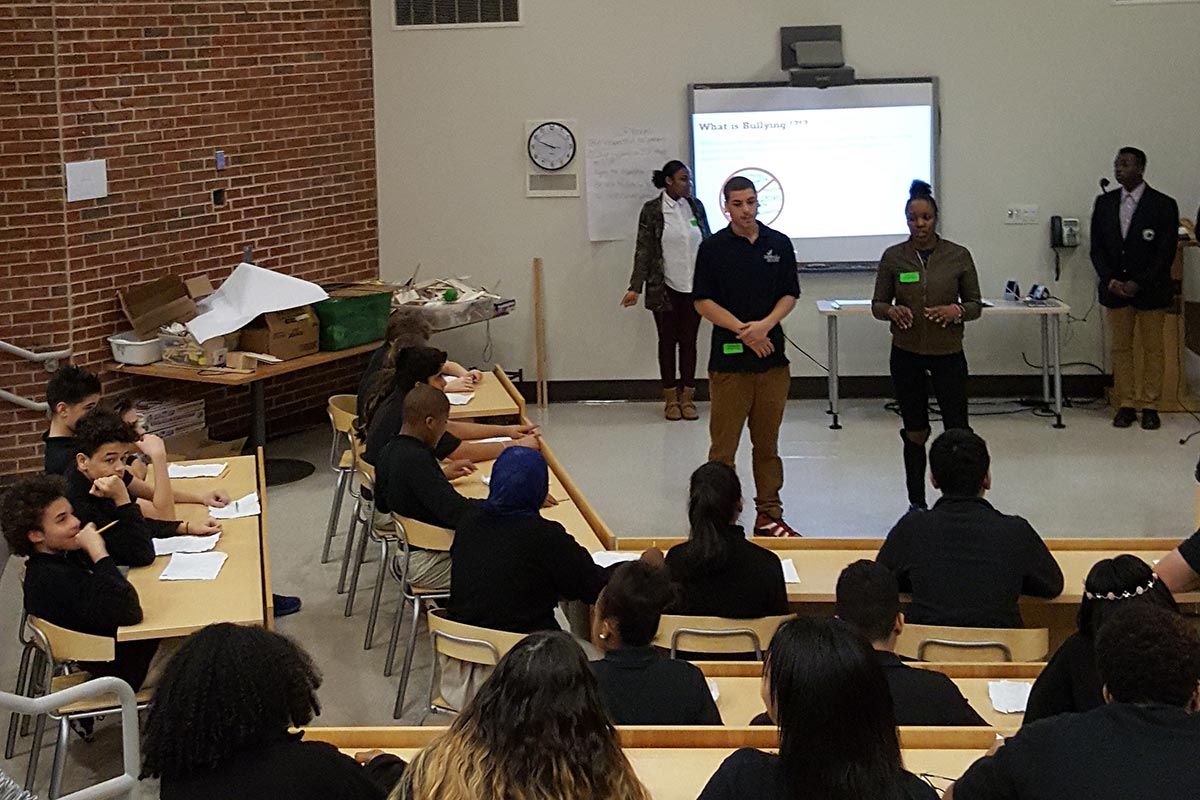
Working with the UConn Students Against Violence in Schools program, students from Weaver High School’s Culinary Arts Academy discuss present to students from the Annie Fisher Montessori Magnet School in Hartford. (Photo by Yolanda Colon)

This past school year, a group of UConn medical and dental students worked with students from the Weaver High School Culinary Arts Academy as part of a larger effort to prevent violence in schools. Damion Grasso, UConn Health assistant professor of psychiatry, is director of the program. Following is his account of the work this year’s group has done.

Are you a medical or dental student at UConn?

We could use your participation for the 2017-2018. Look for an information meeting in early September or contact us for more information.

The program is housed within the Department of Psychiatry and directed by Damion Grasso, PhD, a trained clinical psychologist and researcher in the area of childhood victimization and trauma.

For information about how to participate in the program please contact Dr. Grasso at dgrasso@uchc.edu.

The UConn Students Against Violence in Schools (SAVS) program engages UConn medical and dental students in advocacy work with middle and high-school students focused on promoting healthy relationships and preventing emotional, physical, and sexual violence among youth.

This year we partnered with a stellar team of 17 high school students at Weaver Culinary Arts Academy led by school social worker Yolanda Colon. Students were trained as peer ambassadors against violence by learning about:

  1. The types of violence experienced by youths,
  2. Adverse consequences of violence,
  3. The role of bystanders in preventing and addressing violent behavior,
  4. Steps to take when encountering violence, directly or indirectly, and
  5. School, local, and national resources for seeking help and guidance around these issues.

The Weaver students were then charged with working together to design and implement a project during the school year focused on one or more of these topic areas. The students chose to address issues related to bullying and designed a workshop curriculum, which they successfully implemented in five different Hartford-area middle schools throughout the year.

Weaver student leaders Kiara Hairston and Martin Barrows document the experience from the students’ perspective:

“We collaborated with UConn Health SAVS to make a difference in our school and the communities around us. Our project was about bringing this information to younger peers in middle schools where many of us were once students. We named our group ‘TAGZ’ and put together a presentation that emphasized the warning signs and effects of bullying. We originally planned on only giving one presentation, but teachers, administrators, and students were very impressed – and other schools contacted us to also do additional workshops. We ended up doing five this year.”

Students met on a regular basis with the UConn SAVS team and independently to do this work, which required a significant amount of effort.

When asked about her experience, group member Melicia Mendez commented, “This was a challenging task. Sometimes we were on the verge of giving up …but we kept pushing ourselves. In the end, it was worth it.”

“It was teamwork that helped us get through and make this program successful,” Martin said. “When it came time for them to give their presentations, I think we realized that we were not just trying to start a conversation about bullying, we were opening the door for younger students to take a stand for what they believe is right. We were encouraging these younger students to become positive role models to their peers and others.”

What makes this initiative so powerful is that these messages are coming from other youth and so are received somewhat differently than the same messages coming from adults and authority figures. Youth have a greater impact on their peers than they often realize. With this influence, they have a real opportunity to affect school climate. With empowerment, many will rise to the challenge, as did the students from Weaver Culinary Institute.

“Students need to understand the costs of bullying, especially kids who will be in high school soon. It feels good to be the ones to spread this message,” said student Malik Madric.

“I think we showed teachers and staff that we understand certain situations and are able to be mature about them and do our part in stopping violence,” said Pedro Velazquez, a junior at Weaver. “I myself have seen violence in my life and so I can relate. It feels good to be able to do what I can to stop it.”

After providing a presentation on the topic of bullying, the youth divided the attendees into smaller groups to discuss and role-play situational vignettes in which bystanders have an opportunity to address bullying behavior.

One of the vignettes addressed a student victimized because of his sexual orientation:

Dylan is a 9th grade student who openly identifies as gay. Over the summer, one of Dylan’s friends reports to the principal that other students from the high school have created a website that says, “Dylan is gay” and includes derogatory comments about Dylan. Dylan’s friend tells the principal that Dylan is now afraid to come back to school in the fall because the website includes threats to physically harm him.

Another vignette deals with the issue of racial bullying:

Mohamed, a Jordanian-American student interested in a career in engineering, is involved in a year-long mentoring/internship program where he spends afternoons at a local engineering firm. A couple of workers at the firm refer to him as a “terrorist” and “towel head” throughout the year. In February, Mohamed confides in one of his teachers about the conduct. Mohamed doesn’t want to “rock the boat” because he knows that this is one of the best mentoring opportunities offered by the high school. At the same time, Mohamed has now decided he no longer wants to go into engineering, drops out of college prep courses, and is performing less well in school.

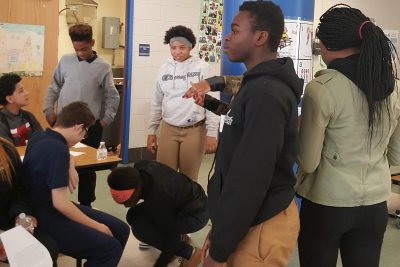
UConn medical and dental students making up the UConn Students Against Violence in Schools group worked with high school students from the Weaver Culinary Arts Academy this past school year. (Photo provided by Damion Grasso)

Each small group was facilitated by one of the Weaver students, who guided the discussion and elicited from the group options for addressing the violence, aiding the victim, and preventing the behavior in the future.

In late May, we celebrated with the Weaver high school TAGZ team and honored them for their achievements. While some of the students will be graduating, returning students expressed high enthusiasm for continuing this work next year and recruiting students from the incoming class to participate. Ms. Colon, who worked closely with the students throughout the year, expressed pride in the students’ accomplishments and seemed eager to partner with the UConn SAVS team in the 2017-2018 school year.

UConn SAVS is also a valuable experience for the medical and dental students that volunteer to work with these high school students.

“Prior to matriculating at UConn for medical school, I served as a full-time tutor and assistant teacher at a charter high school in Boston,” said rising first-year medical student Desai Shyam. “SAVS helps to fill a void that is present in what I imagine are innumerable schools across the country by allowing for an open dialogue about the multiple forms of violence that can so easily percolate the lives of adolescents and youth, especially for those who live in underserved communities. I so valued the work we did because, though it involved a significant educational component, it put the majority of the thinking on the students. The students themselves generated ideas of how best to combat violence and bullying in their school communities, and they then took an admiral degree of initiative in putting those ideas into an actionable agenda. The students I worked with were surprisingly quick to open up regarding their own experiences, and as a future physician, it was both uplifting and formative to hear them speak so passionately about the urgency of bettering the mental and physical well-being of their peers.”

“The UConn SAVS Program formed a necessary relationship between UConnHealth and high school students at Weaver Culinary Arts Academy,” said second-year student Matt Lewin. “Bullying is a serious public health concern amongst adolescents, and I believe that empowering high school students to tackle this issue was a great initiative. I’m happy I had the chance to work with students who were unafraid to stand up against bullying. In the age of Facebook and social media, bullying will present itself in new ways both at school and in the home. With the help of Weaver students, I feel that a strong anti-bullying message and initiative was established and will leave a lasting impact amongst these students.”

“As I have had some background in education, and a passion for working with youth, I was pleased to find that there was a program at UConn where we could work with local students to help combat violence and bullying in schools,” said second-year student Kyle Shin. “With a changing technological landscape and the advent of social media, I think it is important to be able to present the experiences of those of us who have grown up immersed in that world. The interactive nature of the sessions and the ability to present a view different from the traditional teacher/authority figure provides a great way to shift the conversation and approach the problem from the students’ perspective.”

Violence within school communities is a serious problem with up to a third of students reporting some form of victimization by their peers (Hymel & Swearer, 2015). Victimization can come in many forms and has evolved with the advancement of digital technology.

Often, victimized youth experience more than one form of violence and can become overwhelmed with what may best be described as a culture of violence comprised of physical violence (e.g., shoving, pushing), as well as psychological forms such as verbal abuse (e.g., harassing, threatening), social exclusion and humiliation (e.g., spreading rumors), and what we refer to as cyberbullying – the use of social media, texting, and picture sending aimed at taunting, humiliating, and threatening peers.

Surely, exposure to violence can have dire consequences, including depression, anxiety, and traumatic stress, among other forms of impairment at home and school. Moreover, the adverse effects of peer victimization can extend well into adulthood (Lereya, Copeland, Costello, & Wolke, 2015).

A core element of promising programs to reduce youth violence is a focus on training bystanders to identify, help prevent, and effectively respond to peer victimization (Evans, Fraser, & Cotter, 2014).

Indeed, this is what UConn SAVS aims to do.

Are you a medical or dental student at UConn? We could use your participation for the 2017-2018. Look for an information meeting in early September or contact us for more information. The program is housed within the Department of Psychiatry and directed by Damion Grasso, PhD, a trained clinical psychologist and researcher in the area of childhood victimization and trauma. For information about how to participate in the program please contact Dr. Grasso at dgrasso@uchc.edu.


References Cited:

Evans, C. B., Fraser, M. W., & Cotter, K. L. (2014). The effectiveness of school-based bullying prevention programs: A systematic review. Aggression and Violent Behavior, 19(5), 532-544.

Hymel, S., & Swearer, S. M. (2015). Four decades of research on school bullying: An introduction. The American psychologist, 70(4), 293-299. doi: 10.1037/a0038928

Lereya, S. T., Copeland, W. E., Costello, E. J., & Wolke, D. (2015). Adult mental health consequences of peer bullying and maltreatment in childhood: two cohorts in two countries. The Lancet Psychiatry, 2(6), 524-531.

Meet the IT/HealthONE Management Team

HealthONE project directors working on the 7th floor of University Tower, from left, Liz Zibell, Kathy Noel, Carolyn Orrell, and Christopher Carroll. (Photo by Kristin Wallace)

An essential part of HealthONE’s electronic health record (EHR) implementation process, set to go live on April 28, 2018, is the ongoing work of UConn Health IT Department’s two assistant vice presidents and director, and four HealthONE project directors in collaboration with many analysts, architects and engineers.

This management team works closely with the HealthONE leadership team of Denise Purington, BSN, interim CIO; Dr. Dirk Stanley, CMIO; and newly arrived Bryan Kerr, HealthONE’s interim assistant vice president.

The managers oversee the planning, implementation and management process of various information technology needs and HealthONE’s specific EPIC applications.

We would like to introduce you to the IT and HealthONE management team and hear what they think are the ultimate perks and benefits of UConn Health’s upcoming EHR system.

Robert Darby, AVP of IT Strategic Projects and Clinical Systems manages the HealthONE’s team charged with helping to ensure data from existing systems and those systems that are not scheduled to be replaced by EPIC are incorporated into the HealthONE system and available to clinicians and support staff within the HealthONE applications. He also oversees the teams who are developing the necessary operational reports and analytic and business intelligence tools that will be used to manage the business unit, support quality reporting and business and clinical transformation. Some of the tools they use from EPIC include Bridges, Data Courier and Cogito.  In addition to the HealthONE team, Darby manages the Clinical Application Support Team, Project Managers and Clinical Informatics Teams that support all non-HealthONE applications and clinical implementations that play a vital role in the HealthONE implementation project.  Along with over 9 years at UConn Health he has 20 years of health care IT experience in implementation, support, management and integration of clinical systems and environments.
Best perk of HealthONE? Moving from a best of breed (many individual systems) systems approach to a single unified UConn Health enterprise solution.
Number one benefit of HealthONE for UConn Health? Gaining access to information stored within a single database will allow us to act quicker to provider better care to our patients as well as better quality reporting for our patient population and research partners.

Michael Catrini, AVP of Enterprise Technology Systems manages the HealthONE team responsible for connecting our data center to the EPIC data center in Wisconsin. He also manages the team that will ensure the correct HealthONE applications and equipment are installed on thousands of end user devices across the organization. He brings over 20 years of clinical IT experience to the project, including two previous enterprise EHR installations.
Best perk? Reducing the number of applications needed to treat patients.  
Number one benefit? Speed of access to the patient data. The users will be able to quickly reach the correct data at the correct time during patient care.

Carrie Gray, director of Information Security oversees the HealthONE Security Coordinators responsible for building, maintaining and educating users about the security of the HealthONE system. Additionally, she manages the Information Security team responsible for establishing and coordinating the development, management and implementation of information security technologies, policies, standards and procedures for protecting UConn Health’s confidential data and critical systems.
Best perk? The ability to access multiple functions with a single user ID.
Number one benefit? A streamlined approach to granting access to the system based on a user’s responsibilities.

The four HealthONE project directors from left, Carolyn Orrell, Christopher Carroll, Kathy Noel, and Liz Zibell. (Photo by Kristin Wallace)

Liz Zibell, RN, MSN oversees HealthONE’s Clinical applications named ASAP (emergency department), Willow (pharmacy), Stork (obstetrics and labor and delivery) along with the Orders, Clinical Documentation and Infection Control modules and functions. For this role she brings more than 11 years of EHR experience. She has previously managed the clinical informatics teams at UConn Health and served as a clinical transformation specialist for the Cerner Corporation. Her nursing background includes experience in the NICU, pediatrics, home health, and clinical research settings.
Best perk? The strength of the clinical team and their skill sets which will enhance the HealthONE application.
Number one benefit? A safer and more robust data environment for our patients and staff. We will all get there together.

Carolyn Orrell, MBA is responsible for HealthONE’s Access and Revenue Cycle applications which are named Cadence (scheduling), Grand Central (transport, bed planning), Prelude (registration), Resolute HB and PB (hospital billing and professional billing and claims), and HIM/Identity (Health Information Management). She has over 20 years of experience in healthcare IT. She has served in various project management and leadership roles for the implementation of clinical and revenue cycle financial systems and EHRs. In addition, she also attained her Six Sigma Green Belt from the Juran Institute.
Best perk? The new functionality and streamlined processes.
Number one benefit? The EPIC functionality and new third party solutions that will benefit our patients, providers, and staff.

Kathy Noel leads the Ambulatory applications for HealthONE. Her scope of responsibility spans physician office workflows in Ambulatory and Orthopedics, Healthy Planet (population health), MyChart and CareLink (patient and community engagement applications), Canto and Haiku (mobility applications), and Research Studies. She began her IT healthcare journey 28 years ago at the Hospital of St. Raphael, then St. Francis, and arrived nearly 8 years ago at UConn Health as a project manager for the rollout of NextGen. She has managed the development of many clinical applications across the continuum with insight into workflows of many hospital departments.
Best perk? The integration the HealthONE system will provide to connect all the dots between our currently separate systems and the ‘one-stop-shopping’ advantages this gives to our clinicians and our patients.
Number one benefit? HealthONE will provide us with transparency and reporting that has previously been unattainable.

Christopher M. Carroll, MBA, PMP directs HealthONE’s Ancillary applications. He oversees the applications called Beacon (oncology), Beaker (lab), Radiant (radiology and cardiology) and the Optime/Anesthesia (operating rooms and anesthesia) modules for HealthONE. Chris has been with UConn Health’s IT department for the last 7 years. Prior to HealthONE, he was project manager of numerous initiatives including Banner and NextGen. Chris has experience as a consultant, as well as holding various positions across healthcare, insurance, higher education, administrative and financial organizations.
Best perk? The integration of so much clinical information in one place will streamline many workflows.
Number one benefit? It will readily provide patient information to the fingertips of those providing patient care and to those ancillary areas performing tests and procedures.

We encourage you to reach out to any of these leaders with questions or concerns. We also want to thank all the IT and HealthONE team members who are working to deliver the HealthONE system by April 2018 and all those in the organization who have participated in design sessions. Without everyone’s involvement we couldn’t have gotten as far as we have today.

UConn Health July 2017 Programs, Events

June 19, 2017

Here is a list of UConn Health programs scheduled for July and early August 2017. This information will be updated with any additions or other schedule changes. (Updated 7/14)

Living Well With Epilepsy: A Support Group for Young Adults
Saturday, July 1, noon to 1:30 p.m.
, UConn Health Outpatient Pavilion, 2nd Floor, Large Conference Room S2010

The Epilepsy Foundation of Connecticut, in partnership with the UConn Health Department of Neurology, offers a support group for young adults who live with epilepsy. This group is open to those aged 18 to 30 who would like to join others to share experience, gain peer support, and learn together about epilepsy and overcoming its challenges to live well. The group generally meets on the first Saturday of the month. Please call 860-346-1924 or email manzelone.efct@sbcglobal.net for more information.

Bladder Cancer Support Group
Saturday, July 1, 2 to 3 p.m.
, UConn Health, Onyiuke Dining Room
Patients, family members and caregivers (not limited to UConn Health patients) are invited to join others whose lives have been touched by bladder cancer. This support group, established in partnership with the Bladder Cancer Advocacy Network, usually meets on the first Saturday of the month and is the only group of its kind in New England. Call 888-901-BCAN for more information.

Childbirth Preparation Class
Wednesday, July 5, 6 to 10 p.m.
, UConn Health Outpatient Pavilion, 3rd floor conference room S3301
This one-day class covers anatomy and physiology of pregnancy and labor, emotions of pregnancy, nutrition, fetal growth and development, comfort measures for labor, working with unexpected events in labor, cesarean delivery, and practice of relaxation and breathing techniques for labor. Class size is limited to eight couples. Remember to bring two pillows and wear comfortable clothing. Light snack is provided. Fee is $100. Call 800-535-6232 or 860-679-7692 to register or for more information.

UConn Health Epilepsy Support Group
Wednesday, July 5, 6:30 to 8 p.m.
, UConn Health Outpatient Pavilion, 2nd Floor, Large Conference Room S2010

The UConn Health Department of Neurology invites those with epilepsy to a monthly group meeting surrounding life with epilepsy. Discussion topics include coping methods, support systems, and resources. The group generally meets on the first Wednesday of the month. Please call 860-679-3186 for more information.

Breast Cancer Support Group
Thursday, July 6, 6:30 to 7:30 p.m.
, UConn Health, Onyiuke Dining Room
This is a support group intended for women under the age of 45 who’ve been diagnosed with non-metastatic breast cancer. Women at any point in their cancer survivorship journey are welcome. Meetings are the first and third Thursday of the month. To register or more information, call 860-679-7820 or email tillinghast@uchc.edu.

Free Hospital Maternity Tours
Saturday, July 8, 2 p.m.
, UConn Health, University Tower lobby
A representative will guide you through labor and delivery, postpartum, and the nursery at the UConn John Dempsey Hospital. Children and grandparents are welcome. Call 800-535-6232 to register or for more information.

Breast-feeding Class
Wednesday, July 12, 7 to 9 p.m.
, UConn Health Outpatient Pavilion, 3rd floor conference room S3301
A certified lactation consultant leads a discussion of topics including the benefits of breast-feeding, how to get started, and how the rest of the family can help the breast-feeding mother as well as how to continue breast-feeding and working. Fee is $25 per couple. Call 800-535-6232 to register or for more information.

Celiac Disease Nutrition Class
Monday, July 17, 8 to 9 a.m., UConn Health Outpatient Pavilion
A registered dietitian leads a discussion for those with celiac disease or non-celiac gluten sensitivity. This program now is scheduled to meet the third Monday of the month. A physician’s referral is required. Fee is $20. Call 860-679-3245 more information.

Deleted 7/14. Program resumes Sept. 21.
Living With Heart Disease Support Group
Thursday, July 20, 11 a.m. to noon
, UConn Health, University Tower, 2nd floor conference room

Patients with heart disease, along with their families and caregivers, meet on the third Thursday of the month to discuss post-diagnosis topics such as prevention and wellness, social and emotional support, heath-healthy recipes, and coping strategies and resources. Call 860-679-3633 to learn more.

Breast Cancer Support Group
Thursday, July 20, 6:30 to 7:30 p.m.
, UConn Health, Onyiuke Dining Room
This is a support group intended for women under the age of 45 who’ve been diagnosed with non-metastatic breast cancer. Women at any point in their cancer survivorship journey are welcome. Meetings are the first and third Thursday of the month. To register or more information, call 860-679-7820 or email tillinghast@uchc.edu.

Infertility Peer Support Group
Thursday, July 20, 7 p.m.
, Center for Advanced Reproductive Services, 2 Batterson Park Road, Farmington.

The Greater Hartford chapter of RESOLVE, a national nonprofit resource for those facing the challenges of infertility, offers support, information and confidential, informal, peer-led discussions on the third Thursday of the month. To learn more or to check for weather-related cancellation, call 860-523-8337.

Stroke Survivor Group
Wednesday, July 26, noon to 1 p.m.
, UConn Health Outpatient Pavilion, 3rd floor
The UConn Health Stroke Center invites stroke survivors, families and caregivers to a monthly group meeting to discuss topics such as prevention, coping methods, support systems, rehabilitation tips, resources, and promoting independence. The Stroke Survivor Group generally meets on the fourth Wednesday of the month. Call 860-679-4846 for more information.

Free Workshop: “Things to Consider Before Joining a Research Study”
Monday, July 31, 5 p.m.
, UConn Health, Onyiuke Dining Room
The UConn Health Human Subjects Protection Office offers an educational session about the rights and responsibilities of participants in research projects on the last Monday of the month. Registration is required: 860-679-8802 or cagganello@uchc.edu.

UConn Health Epilepsy Support Group
Wednesday, Aug. 2, 6:30 to 8 p.m.
, UConn Health Outpatient Pavilion, 2nd Floor, Large Conference Room S2010
The UConn Health Department of Neurology invites those with epilepsy to a monthly group meeting surrounding life with epilepsy. Discussion topics include coping methods, support systems, and resources. The group generally will meet on the first Wednesday of the month. Please call 860-679-3186 for more information.

Breast Cancer Support Group
Thursday, Aug. 3, 6:30 to 7:30 p.m.
, UConn Health, Onyiuke Dining Room
This is a support group intended for women under the age of 45 who’ve been diagnosed with non-metastatic breast cancer. Women at any point in their cancer survivorship journey are welcome. Meetings are the first and third Thursday of the month. To register or more information, call 860-679-7820 or email tillinghast@uchc.edu.

Childbirth Preparation Class
Saturday, Aug. 5, 8:30 a.m. to 12:30 p.m.
, UConn Health Outpatient Pavilion, 3rd floor conference room S3301
This one-day class covers anatomy and physiology of pregnancy and labor, emotions of pregnancy, nutrition, fetal growth and development, comfort measures for labor, working with unexpected events in labor, cesarean delivery, and practice of relaxation and breathing techniques for labor. Class size is limited to eight couples. Remember to bring two pillows and wear comfortable clothing. Light snack is provided. Fee is $100. Call 800-535-6232 or 860-679-7692 to register or for more information.

Living Well With Epilepsy: A Support Group for Young Adults
Saturday, Aug. 5, noon to 1:30 p.m.
, UConn Health Outpatient Pavilion, 2nd Floor, Large Conference Room S2010
The Epilepsy Foundation of Connecticut, in partnership with the UConn Health Department of Neurology, offers a support group for young adults who live with epilepsy. This group is open to those aged 18 to 30 who would like to join others to share experience, gain peer support, and learn together about epilepsy and overcoming its challenges to live well. The group generally meets on the first Saturday of the month. Please call 860-346-1924 or email manzelone.efct@sbcglobal.net for more information.

Bladder Cancer Support Group
Saturday, Aug. 5, 2 to 3 p.m.
, UConn Health, Onyiuke Dining Room
Patients, family members and caregivers (not limited to UConn Health patients) are invited to join others whose lives have been touched by bladder cancer. This support group, established in partnership with the Bladder Cancer Advocacy Network, usually meets on the first Saturday of the month and is the only group of its kind in New England. Call 888-901-BCAN for more information.

Free Cosmetology Services for Cancer Survivors
Monday, Aug. 14, 1 to 3 p.m.
, UConn Health Outpatient Pavilion, 4th floor
“Look Good…Feel Better” is a free program to help improve the self-image and self-esteem of women experiencing appearance-related side effects from cancer treatment. During this hands-on workshop, a trained volunteer certified cosmetologist will teach women how to cope with skin changes and hair loss using cosmetic and skin care products donated by the cosmetic industry. Classes are offered every other month and are not limited to UConn Health patients. Please call 860-679-7820 to register (required).

Breast-feeding Class
Tuesday, Aug. 15, 7 to 9 p.m.
, UConn Health Outpatient Pavilion, 3rd floor conference room S3301
A certified lactation consultant leads a discussion of topics including the benefits of breast-feeding, how to get started, and how the rest of the family can help the breast-feeding mother as well as how to continue breast-feeding and working. Fee is $25 per couple. Call 800-535-6232 to register or for more information.

Directions to UConn Health are available at http://bit.ly/get2uch.

Active Shooter Awareness

June 13, 2017

UConn Health leadership and staff participated on June 7 in a U.S. Department of Homeland Security FEMA led tabletop drill exercise to further enhance its response to an emergency situation such as an active shooter.

“As a campus we need to make sure we are always as prepared as possible for a natural or man-made disaster such as workplace violence that can occur at any time or anywhere. This is why we drill regularly at UConn Health,” says Bryan Gran, the new emergency management specialist at UConn Health who led the interactive discussion-based exercise.

Institutional representatives hailed from across the departments of fire, police, hospital, facilities, communications, nutrition and emergency departments at UConn Health. In addition, representatives participated from the Connecticut State Division of Emergency Management and Homeland Security, the West Hartford Fire Department and seven other institutions from across the country.

“Very few people are trained to know what to do for their personal protection in an active shooter situation,” says Joe Curreri, chief of UConn Health Police. This is why since 2014 UConn Health has made active shooter awareness and education mandatory for all new employees and students during their onboarding orientation.

Curreri added, “Education about active shooters is not designed to alarm employees, but to make them more aware of the possibility of this type of event occurring whether at work or in their day-to-day lives and to make them more aware of their response options should they find themselves in this situation.”

In fact, a study performed by Johns Hopkins Office of Critical Event Preparedness found that there were more than 150 hospital-related shootings nationwide from 2000 to 2011, in more than 40 states, and with more than 235 people killed or injured. Unfortunately, hospital related shootings have been on the rise since the study was completed.

Should you ever find yourself in harm’s way take proactive steps to protect yourself and help save more lives.

Important Tips to Remember:

  • Be aware: To help prevent an event’s occurrence, make sure to report any suspicious warning signs of a potential active shooter or violent person to the Police immediately by calling 9-1-1.
  • Know the Emergency Codes: Remember to wear your UConn Health identification card at all times so you can quickly refer to the back of it for any announced emergency hospital codes. A ‘Silver’ alert stands for an active weapon threat.
  • Remember to ‘Run, Hide, Fight’: These three action may make the difference in your survival during an active shooter situation.) Run: Try to escape or evacuate the active shooter’s area if you can to safety. Only you are important so leave any belongings behind. As you run verbally alert others to prevent their harm and call 9-1-1 once you are safe.

2.) Hide: If you can’t escape the active shooter’s area, find a place to hide behind a locked or barricaded door or even behind a large object. Remain quiet and remember to silence your phone.

3.) Fight: As a last resort, if you can’t run or hide, fight with aggression against the active shooter assailant whether alone or as a group.
For more tips on emergency preparedness, visit: https://health.uconn.edu/police/crime-prevention/.


Looking at Us: Cliff Williams, Electrician of the Comedy Circuit

June 1, 2017

Spend enough time in a UConn Health building and there’s a good chance you’ll cross paths with a tall, lanky, bearded fellow in a tradesman’s uniform… and he’ll try to make you laugh. Known to many as “The Joke Guy,” Cliff Williams joined UConn Health 16 years ago for a job that, despite our comical encounters with him, is actually pretty serious. He lives in Farmington with his wife, Joan, who also works at UConn Health, as a business services manager in the UConn School of Dental Medicine.

Cliff Williams is an electrician who’s been known to share a joke or two with UConn Health colleagues on his way to or from a job site, like this generator room in the University Tower. (Photo by Janine Gelineau)

What is your day job?

My job here is not being the joke man, that’s for sure. I’m a QCW electrician. QCW stands for “quality craft worker”—I didn’t dream up the silly name. In electrical, we’re responsible for maintaining the reliability of the electrical system in the Health Center, all the buildings here, and the outbuildings. We have certain maintenance things we do on a regular basis and also sometimes we’re scrambling because there’s a problem somewhere that needs to be corrected. It could be lights not working, or outlets not working, and we also assist the plumbers and the HVAC guys when they have electrical problems with their equipment. There’s a lot of stuff here, and no matter how well you maintain anything, stuff can break. That’s why we’re here, to try to keep the lights on and the power flowing for all of the patients and staff here.

A lot of folks here recognize you not as the electrician but as the tall bearded guy who tells jokes. How did that come to be?

I think this has been going on for maybe the last five or six years. Most of my jokes are puns. I happen to enjoy puns very much. I could have gotten that appreciation from [Hartford radio legend] Bob Steele. I admired his sense of humor and he did not tell any what he called “parlor” jokes, and I always liked that. There are people who see me and want me to stop and tell them a joke. They know that I’m normally good for a joke.

One thing that’s interesting is, I have a colleague, George Kazimierczak, also a QCW electrician. Sometimes George has a beard, and he’s tall and thin, and people often confuse the two of us. From time to time, people are stopping George in the elevator or walking down the hall and they are demanding a joke from him. Sometimes they don’t want to believe that he’s not me.

And I should point out, my corny jokes, women seem to appreciate them more than men. I could be in the elevator, and a woman will look at me and say, “Well?” And I say, “Excuse me? Well what?” And she’ll say “Aren’t you The Joke Guy? I’m waiting.” So to some degree, sometimes I’m on the spot to perform.

I’ve told well over a hundred jokes, but I don’t remember the ones I used last week.

Cliff Williams

Favorite movie
“Zardoz”

Favorite author
John Steinbeck

Favorite vacation spot
Tulum, Mexico

Favorite delicacy
Corned beef with sauerkraut

Something about you today that your younger self would never believe
That I’m still alive!

What’s one of your favorite jokes from over the years, that you can remember?

What’s the difference between a well-dressed man on a unicycle and a poorly dressed man on a bicycle?

Attire.

Does it ever happen that people see you and try to avoid you because they don’t want to hear a joke?

No… oh, wait a minute. There’s one doctor, a researcher, Ph.D., he sees me and tries to avoid me. There is at least one person who tries to avoid me.

When you’re not at work, what do you like to do?

We enjoy very much working in our garden. Joan enjoys her flowers very much, and I’m in charge of the vegetable garden. We enjoy our annual vacation to Mexico in the winter, because it’s very nice to get out of here, and it’s much too cold to do yardwork anyway. Tulum, Mexico, has been our favorite place for eight or more years. And I do speak a little German. I actually know three and a half German jokes that I can tell, for what that’s worth.

Do you have a joke you’d like to leave us with?

What do dogs do that people step in?

Pants!

Second Project Search Graduation Slated June 2

May 31, 2017

Kristin Sadowsky (second from left), an intern with Favarh Project SEARCH, learns administrative support tasks from her mentors Michelle Thompson , Angela Rizzolo and skills trainer Pam Applewhite-Miller. (Photo by R. Wright)

Nine interns with Project SEARCH, an innovative program designed to prepare young adults with intellectual and developmental disabilities (IDD) for careers, not just jobs, will be graduating from the program at a special “bridge ceremony” on Friday, June 2.

Project SEARCH is the most successful youth transition program in the nation at placing young adults with IDD in gainful employment. Connecticut’s only program, a partnership between Favarh – The Arc of the Farmington Valley – and UConn Health, is located at the UConn Health Farmington campus. At the program, young people with IDD are demonstrating that when given the opportunity and proper supports to succeed, they can and do exceed, often beyond our preconceived notions of what is possible.

Vanessa Flenke (center), an intern with Favarh Project SEARCH, learns about delivering excellent patient care at UMG Ophthalmology from her mentors Cheryl Berry and Vivian Holly. (Photo by Ania Scott)

Project SEARCH was founded in 1996 at the Cincinnati Children’s Hospital. The program is a one-year, unpaid internship program designed for students either in their last year of high school or graduates in their first year out of school.

The largest private employer in Canton with 275 employees, Favarh was founded in 1958 by eight local families who all wanted a better life for their children with intellectual disabilities. Today, Favarh is a local chapter of the Arc, the world’s largest community-based organization for people with intellectual, physical and developmental disabilities. Favarh supports more than 350 children, young adults, adults, seniors and families throughout the Greater Farmington Valley area and beyond.

Media contact:  Bill Neagus,  wneagus@favarh.org

UConn Health June 2017 Programs, Events

May 24, 2017

Here is a list of UConn Health programs scheduled for June and early July 2017. This information will be updated with any additions or other schedule changes.
Breast Cancer Support Group
Thursday, June 1, 6:30 to 7:30 p.m.
, UConn Health, Onyiuke Dining Room
This is a support group intended for women under the age of 45 who’ve been diagnosed with non-metastatic breast cancer. Women at any point in their cancer survivorship journey are welcome. Meetings are the first and third Thursday of the month. To register or more information, call 860.679.7820 or email tillinghast@uchc.edu.

Living Well With Epilepsy: A Support Group for Young Adults
Saturday, June 3, noon to 1:30 p.m.
, UConn Health Outpatient Pavilion, 2nd Floor, Large Conference Room S2010

The Epilepsy Foundation of Connecticut, in partnership with the UConn Health Department of Neurology, offers a support group for young adults who live with epilepsy. This group is open to those aged 18 to 30 who would like to join others to share experience, gain peer support, and learn together about epilepsy and overcoming its challenges to live well. The group generally meets on the first Saturday of the month. Please call 860-346-1924 or email manzelone.efct@sbcglobal.net for more information.

Bladder Cancer Support Group
Saturday, June 3, 2 to 3 p.m.
, UConn Health, Onyiuke Dining Room
Patients, family members and caregivers (not limited to UConn Health patients) are invited to join others whose lives have been touched by bladder cancer. This support group, established in partnership with the Bladder Cancer Advocacy Network, usually meets on the first Saturday of the month and is the only group of its kind in New England. Call 888-901-BCAN for more information.

UConn Health Epilepsy Support Group
Wednesday, June 7, 6:30 to 8 p.m.
, UConn Health Outpatient Pavilion, 2nd Floor, Large Conference Room S2010

The UConn Health Department of Neurology invites those with epilepsy to a monthly group meeting surrounding life with epilepsy. Discussion topics include coping methods, support systems, and resources. The group generally will meet on the first Wednesday of the month. Please call 860-679-3186 for more information.

Childbirth Preparation Class
Saturday, June 10, 8:30 a.m. to 12:30 p.m.
, UConn Health Outpatient Pavilion, 3rd floor conference room S3301
This one-day class covers anatomy and physiology of pregnancy and labor, emotions of pregnancy, nutrition, fetal growth and development, comfort measures for labor, working with unexpected events in labor, cesarean delivery, and practice of relaxation and breathing techniques for labor. Class size is limited to eight couples. Remember to bring two pillows and wear comfortable clothing. Light snack is provided. Fee is $100. Call 800-535-6232 or 860-679-7692 to register or for more information.

Breast-feeding Class
Wednesday, June 13, 7 to 9 p.m.
, UConn Health Outpatient Pavilion, 3rd floor conference room S3301
A certified lactation consultant leads a discussion of topics including the benefits of breast-feeding, how to get started, and how the rest of the family can help the breast-feeding mother as well as how to continue breast-feeding and working. Fee is $25 per couple. Call 800-535-6232 to register or for more information.

Living With Heart Disease Support Group
Thursday, June 15, 11 a.m. to noon
, UConn Health, University Tower, 2nd floor conference room

Patients with heart disease, along with their families and caregivers, meet on the third Thursday of the month to discuss post-diagnosis topics such as prevention and wellness, social and emotional support, heath-healthy recipes, and coping strategies and resources. Call 860-679-3633 to learn more.

Breast Cancer Support Group
Thursday, June 15, 6:30 to 7:30 p.m.
, UConn Health, Onyiuke Dining Room
This is a support group intended for women under the age of 45 who’ve been diagnosed with non-metastatic breast cancer. Women at any point in their cancer survivorship journey are welcome. Meetings are the first and third Thursday of the month. To register or more information, call 860.679.7820 or email tillinghast@uchc.edu.

Infertility Peer Support Group
Thursday, June 15, 7 p.m.
, Center for Advanced Reproductive Services, 2 Batterson Park Road, Farmington.

The Greater Hartford chapter of RESOLVE, a national nonprofit resource for those facing the challenges of infertility, offers support, information and confidential, informal, peer-led discussions on the third Thursday of the month. To learn more or to check for weather-related cancellation, call 860-523-8337.

Free Hospital Maternity Tours
Saturday, June 17, 2 p.m.
, UConn Health, University Tower lobby
A representative will guide you through labor and delivery, postpartum, and the nursery at the UConn John Dempsey Hospital. Children and grandparents are welcome. Call 800-535-6232 to register or for more information.

Celiac Disease Nutrition Class
Monday, June 19, 8 to 9 a.m., UConn Health Outpatient Pavilion
A registered dietitian leads a discussion for those with celiac disease or non-celiac gluten sensitivity. This program now is scheduled to meet the third Monday of the month. A physician’s referral is required. Fee is $20. Call 860-679-3245 more information.

Free Cosmetology Services for Cancer Survivors
Monday, June 19, 1 to 3 p.m.
, UConn Health Outpatient Pavilion, 4th floor

“Look Good…Feel Better” is a free program to help improve the self-image and self-esteem of women experiencing appearance-related side effects from cancer treatment. During this hands-on workshop, a trained volunteer certified cosmetologist will teach women how to cope with skin changes and hair loss using cosmetic and skin care products donated by the cosmetic industry. Classes are offered every other month and are not limited to UConn Health patients. Please call 860-679-7820 to register (required).

Free Workshop: “Things to Consider Before Joining a Research Study”
Monday, June 26, 5 p.m.
, UConn Health, Onyiuke Dining Room
The UConn Health Human Subjects Protection Office offers an educational session about the rights and responsibilities of participants in research projects on the last Monday of the month. Registration is required: 860-679-8802 or cagganello@uchc.edu.

Stroke Survivor Group
Wednesday, June 28, noon to 1 p.m.
, UConn Health Outpatient Pavilion, 3rd floor
The UConn Health Stroke Center invites stroke survivors, families and caregivers to a monthly group meeting to discuss topics such as prevention, coping methods, support systems, rehabilitation tips, resources, and promoting independence. The Stroke Survivor Group generally meets on the fourth Wednesday of the month. Call 860-679-4846 for more information.

Living Well With Epilepsy: A Support Group for Young Adults
Saturday, July 1, noon to 1:30 p.m.
, UConn Health Outpatient Pavilion, 2nd Floor, Large Conference Room S2010
The Epilepsy Foundation of Connecticut, in partnership with the UConn Health Department of Neurology, offers a support group for young adults who live with epilepsy. This group is open to those aged 18 to 30 who would like to join others to share experience, gain peer support, and learn together about epilepsy and overcoming its challenges to live well. The group generally meets on the first Saturday of the month. Please call 860-346-1924 or email manzelone.efct@sbcglobal.net for more information.

Bladder Cancer Support Group
Saturday, July 1, 2 to 3 p.m.
, UConn Health, Onyiuke Dining Room
Patients, family members and caregivers (not limited to UConn Health patients) are invited to join others whose lives have been touched by bladder cancer. This support group, established in partnership with the Bladder Cancer Advocacy Network, usually meets on the first Saturday of the month and is the only group of its kind in New England. Call 888-901-BCAN for more information.

Childbirth Preparation Class
Wednesday, July 5, 6 to 10 p.m.
, UConn Health Outpatient Pavilion, 3rd floor conference room S3301
This one-day class covers anatomy and physiology of pregnancy and labor, emotions of pregnancy, nutrition, fetal growth and development, comfort measures for labor, working with unexpected events in labor, cesarean delivery, and practice of relaxation and breathing techniques for labor. Class size is limited to eight couples. Remember to bring two pillows and wear comfortable clothing. Light snack is provided. Fee is $100. Call 800-535-6232 or 860-679-7692 to register or for more information.

UConn Health Epilepsy Support Group
Wednesday, July 5, 6:30 to 8 p.m.
, UConn Health Outpatient Pavilion, 2nd Floor, Large Conference Room S2010
The UConn Health Department of Neurology invites those with epilepsy to a monthly group meeting surrounding life with epilepsy. Discussion topics include coping methods, support systems, and resources. The group generally meets on the first Wednesday of the month. Please call 860-679-3186 for more information.

Breast Cancer Support Group
Thursday, July 6, 6:30 to 7:30 p.m.
, UConn Health, Onyiuke Dining Room
This is a support group intended for women under the age of 45 who’ve been diagnosed with non-metastatic breast cancer. Women at any point in their cancer survivorship journey are welcome. Meetings are the first and third Thursday of the month. To register or more information, call 860.679.7820 or email tillinghast@uchc.edu.

Free Hospital Maternity Tours
Saturday, July 8, 2 p.m.
, UConn Health, University Tower lobby
A representative will guide you through labor and delivery, postpartum, and the nursery at the UConn John Dempsey Hospital. Children and grandparents are welcome. Call 800-535-6232 to register or for more information.

Breast-feeding Class
Wednesday, July 12, 7 to 9 p.m.
, UConn Health Outpatient Pavilion, 3rd floor conference room S3301
A certified lactation consultant leads a discussion of topics including the benefits of breast-feeding, how to get started, and how the rest of the family can help the breast-feeding mother as well as how to continue breast-feeding and working. Fee is $25 per couple. Call 800-535-6232 to register or for more information.

Directions to UConn Health are available at http://bit.ly/get2uch.